鲐 (tái) means "Mackerel" in Chinese. It has 13 strokes with the radical 鱼.
Rated 4.2/5 in difficulty (advanced).
Appears in 3+ common words including 鲐鱼 (tái yú), 鲐鱼罐头 (tái yú guàn tou), 鲜鲐鱼 (xiān tái yú).
Due to its 13 strokes, Hanzi Writer's error detection shows 鲐 requires focused practice — most learners need 10+ attempts for consistent accuracy.
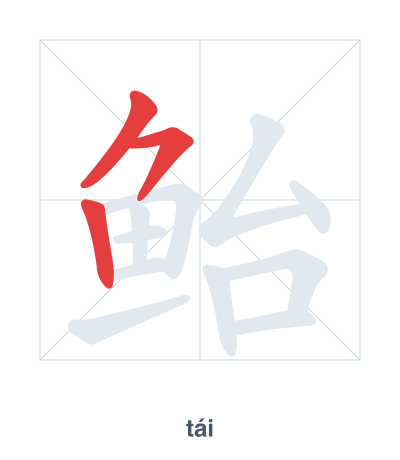
Open Hanzi Writer to see the animated stroke order and practice writing 鲐 with real-time feedback.
The character 鲐 (tái) is written with 13 strokes. Follow the standard Chinese stroke order: top to bottom, left to right, outside before inside. The radical 鱼 is one of its key components.
Practice the correct stroke order with the Hanzi Writer app to see animated stroke-by-stroke guidance with real-time feedback.
鲐 means Mackerel.
鲐 is a phono-semantic compound character. The radical 鱼 (fish) indicates the meaning relates to fish, while the component 台 (tái) provides the pronunciation. Thus, 鲐 represents a type of fish called mackerel.
💡 Memory Tip: Imagine a mackerel (鱼) performing a dance on top of a raised platform (台).
鲐鱼生活在海里。
tái yú shēng huó zài hǎi lǐ
Mackerel live in the sea.
他买了鲐鱼罐头。
tā mǎi le tái yú guàn tou
He bought canned mackerel.
这里的鲜鲐鱼很贵。
zhè lǐ de xiān tái yú hěn guì
The fresh mackerel here is very expensive.
Open Hanzi Writer to see the animated stroke order and practice writing 鲐 with real-time feedback.
✨ Animated stroke order · Handwriting recognition · HSK-graded practice · Free to use
鲐 is a phono-semantic compound. The left part 鱼 (fish) indicates it is a type of fish, and the right part 台 (tái) provides the pronunciation. Together they form the character for mackerel.