铊 (tā) means "thallium" in Chinese. It has 10 strokes with the radical 钅.
Rated 4.2/5 in difficulty (advanced).
Appears in 3+ common words including 铊中毒 (tā zhòng dú), 金属铊 (jīn shǔ tā), 铊盐 (tā yán).
Due to its 10 strokes, Hanzi Writer's error detection shows 铊 requires focused practice — most learners need 10+ attempts for consistent accuracy.
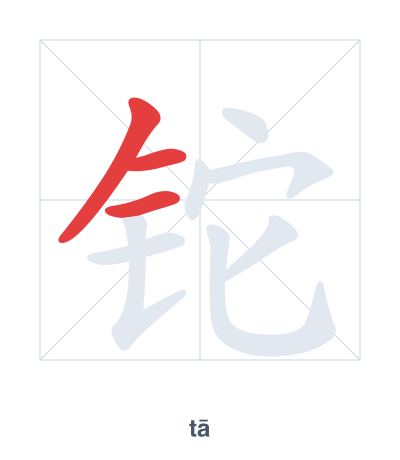
Open Hanzi Writer to see the animated stroke order and practice writing 铊 with real-time feedback.
The character 铊 (tā) is written with 10 strokes. Follow the standard Chinese stroke order: top to bottom, left to right, outside before inside. The radical 钅 is one of its key components.
Practice the correct stroke order with the Hanzi Writer app to see animated stroke-by-stroke guidance with real-time feedback.
铊 means thallium.
The character 铊 combines the metal radical 钅 (indicating a metallic element) with 它 (tā, meaning 'it' or 'other') as a phonetic hint for the pronunciation. It was created in modern times as a transliteration for the chemical element thallium.
💡 Memory Tip: Picture a metal ingot (钅) shaped like a coiled snake (它) because thallium is dangerously toxic—don't touch that 'it'!
他发生了铊中毒。
tā fā shēng le tā zhòng dú
He suffered from thallium poisoning.
这种金属是铊。
zhè zhǒng jīn shǔ shì tā
This metal is thallium.
实验室里有铊盐。
shí yàn shì lǐ yǒu tā yán
There are thallium salts in the laboratory.
Open Hanzi Writer to see the animated stroke order and practice writing 铊 with real-time feedback.
✨ Animated stroke order · Handwriting recognition · HSK-graded practice · Free to use
铊 is a left-right character. The left part 钅 (jīn) is the metal radical, showing that this character represents a metal element. The right part 它 (tā) provides the pronunciation and has no direct meaning connection.