抒 (shū) means "Express / Vent" in Chinese. It has 7 strokes with the radical 扌, and is HSK Level 7.
Rated 3.5/5 in difficulty (challenging).
Harder than 18% of HSK Level 7 characters.
Appears in 3+ common words including 抒发 (shū fā), 抒情 (shū qíng), 抒写 (shū xiě).
Due to its 7 strokes, Hanzi Writer's error detection shows 抒 requires focused practice — most learners need 10+ attempts for consistent accuracy.
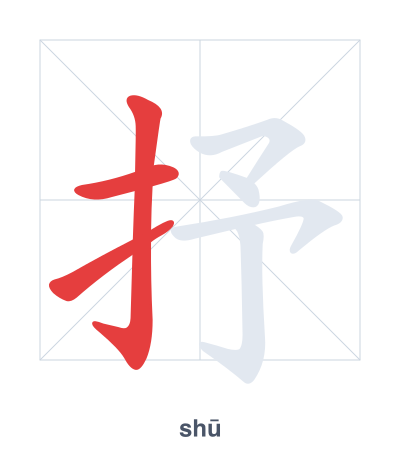
Open Hanzi Writer to see the animated stroke order and practice writing 抒 with real-time feedback.
The character 抒 (shū) is written with 7 strokes. Follow the standard Chinese stroke order: top to bottom, left to right, outside before inside. The radical 扌 is one of its key components.
Practice the correct stroke order with the Hanzi Writer app to see animated stroke-by-stroke guidance with real-time feedback.
抒 means Express / Vent.
As an HSK Level 7 character, 抒 is an intermediate-level character.
抒 combines the hand radical 扌 (action) with 予 (to give), meaning to give out or express feelings through hand gestures or writing. Originally depicted pouring out emotions, like a hand releasing something held within.
💡 Memory Tip: Imagine your hand (扌) gives (予) a giant sigh of relief as you finally vent your feelings.
抒发内心的情感。
shū fā nèi xīn de qíng gǎn
Express one's inner feelings.
这是一首抒情歌。
zhè shì yī shǒu shū qíng gē
This is a lyrical song.
抒写美好的生活。
shū xiě měi hǎo de shēng huó
Write about a beautiful life.
Open Hanzi Writer to see the animated stroke order and practice writing 抒 with real-time feedback.
✨ Animated stroke order · Handwriting recognition · HSK-graded practice · Free to use
抒 is made of the radical 扌 (hand) on the left and the component 予 (to give) on the right. The hand radical suggests an action, while 予 adds the idea of giving or sending out, together meaning to express or vent emotions as if giving them out with your hand.