贳 (shì) means "Borrow; buy on credit" in Chinese. It has 9 strokes with the radical 贝.
Rated 4/5 in difficulty (challenging).
Appears in 3+ common words including 贳贷 (shì dài), 贳借 (shì jiè), 贳账 (shì zhàng).
Due to its 9 strokes, Hanzi Writer's error detection shows 贳 requires focused practice — most learners need 10+ attempts for consistent accuracy.
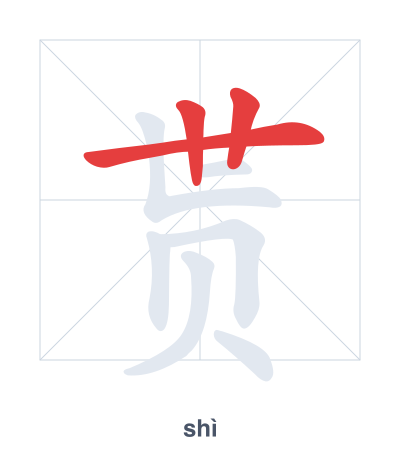
Open Hanzi Writer to see the animated stroke order and practice writing 贳 with real-time feedback.
The character 贳 (shì) is written with 9 strokes. Follow the standard Chinese stroke order: top to bottom, left to right, outside before inside. The radical 贝 is one of its key components.
Practice the correct stroke order with the Hanzi Writer app to see animated stroke-by-stroke guidance with real-time feedback.
贳 means Borrow; buy on credit.
贳 combines the radical 贝 (shell, representing money) with the phonetic component 世 (shì, meaning generation/world), suggesting a financial arrangement that extends across time or generations—hence borrowing or buying on credit.
💡 Memory Tip: Picture a shell (贝) being handed over to secure a loan for an entire world (世) of goods—you're buying the whole world on credit!
他向银行申请贳贷。
tā xiàng yín háng shēn qǐng shì dài
He applied for a loan from the bank.
这些工具可以贳借。
zhè xiē gōng jù kě yǐ shì jiè
These tools can be borrowed.
他喜欢在小店贳账。
tā xǐ huān zài xiǎo diàn shì zhàng
He likes buying on credit at the small shop.
Open Hanzi Writer to see the animated stroke order and practice writing 贳 with real-time feedback.
✨ Animated stroke order · Handwriting recognition · HSK-graded practice · Free to use
贳 is made of the radical 贝 (shell/money) on the left and 世 (world/generation) on the right. The 贝 suggests money or value, while 世 provides pronunciation, together meaning to borrow or buy on credit.