芍 (sháo) means "Peony" in Chinese. It has 6 strokes with the radical 艹.
Rated 3.2/5 in difficulty (challenging).
Appears in 3+ common words including 芍药 (sháo yào), 芍药花 (sháo yào huā), 红芍 (hóng sháo).
Due to its 6 strokes, Hanzi Writer's error detection shows 芍 requires focused practice — most learners need 10+ attempts for consistent accuracy.
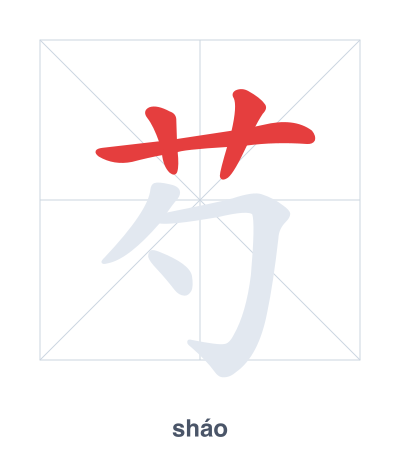
Open Hanzi Writer to see the animated stroke order and practice writing 芍 with real-time feedback.
The character 芍 (sháo) is written with 6 strokes. Follow the standard Chinese stroke order: top to bottom, left to right, outside before inside. The radical 艹 is one of its key components.
Practice the correct stroke order with the Hanzi Writer app to see animated stroke-by-stroke guidance with real-time feedback.
芍 means Peony.
芍 is a phono-semantic compound: the grass radical 艹 indicates it's a plant, while 勺 (spoon) provides the pronunciation sháo. The peony's rounded petals or root shape were likened to a spoon, giving the character its form.
💡 Memory Tip: Imagine a peony flower growing in the grass (艹), with a tiny spoon (勺) nestled in its petals, ready to scoop up its fragrance.
芍药花开了。
sháo yào huā kāi le
The peonies are in bloom.
这朵芍药很红。
zhè duǒ sháo yào hěn hóng
This peony is very red.
公园里有红芍。
gōng yuán lǐ yǒu hóng sháo
There are red peonies in the park.
Open Hanzi Writer to see the animated stroke order and practice writing 芍 with real-time feedback.
✨ Animated stroke order · Handwriting recognition · HSK-graded practice · Free to use
芍 is composed of the radical 艹 (grass) on top, indicating a plant or herb, and the phonetic component 勺 (spoon) below, which hints at the pronunciation sháo. The grass radical tells you it is a type of flower, while the spoon part is purely for sound, not meaning.