磉 (sǎng) means "stone plinth" in Chinese. It has 15 strokes with the radical 石.
Rated 4.2/5 in difficulty (advanced).
Appears in 3+ common words including 磉石 (sǎng shí), 柱磉 (zhù sǎng), 磉墩 (sǎng dūn).
Due to its 15 strokes, Hanzi Writer's error detection shows 磉 requires focused practice — most learners need 10+ attempts for consistent accuracy.
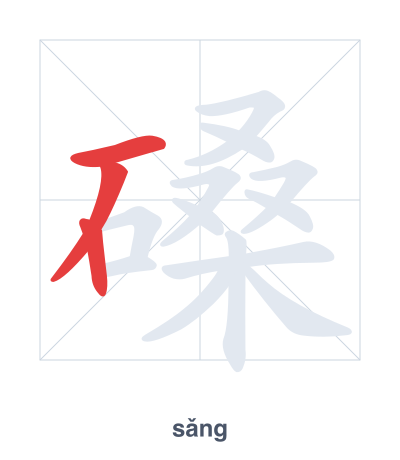
Open Hanzi Writer to see the animated stroke order and practice writing 磉 with real-time feedback.
The character 磉 (sǎng) is written with 15 strokes. Follow the standard Chinese stroke order: top to bottom, left to right, outside before inside. The radical 石 is one of its key components.
Practice the correct stroke order with the Hanzi Writer app to see animated stroke-by-stroke guidance with real-time feedback.
磉 means stone plinth.
磉 is a phono-semantic compound combining the 'stone' radical 石 (meaning stone or rock) with the phonetic component 桑 (mulberry tree, pronounced sāng). The character represents a stone plinth or base, often used as a foundation for pillars or columns in traditional Chinese architecture.
💡 Memory Tip: Picture a mulberry tree (桑) growing out of a solid stone base (石), anchoring it firmly like a plinth supports a pillar.
这里的磉石很坚固。
zhè lǐ de sǎng shí hěn jiān gù
The stone foundations here are very solid.
这个柱磉已经很久了。
zhè ge zhù sǎng yǐ jīng hěn jiǔ le
This stone plinth has been here for a long time.
工人们在搬运磉墩。
gōng rén men zài bān yùn sǎng dūn
Workers are carrying stone plinths.
Open Hanzi Writer to see the animated stroke order and practice writing 磉 with real-time feedback.
✨ Animated stroke order · Handwriting recognition · HSK-graded practice · Free to use
The character 磉 is composed of the radical 石 (stone) on the left and the phonetic component 桑 (sāng, mulberry) on the right. The 石 radical indicates the character's connection to stone, while 桑 provides pronunciation guidance. Together they create a character meaning a stone base or plinth used in construction.