溱 (qín) means "Zhen (name of a river)" in Chinese. It has 13 strokes with the radical 氵.
Rated 4.2/5 in difficulty (advanced).
Appears in 3+ common words including 溱溱 (qín qín), 溱水 (qín shuǐ), 溱洧 (qín wěi).
Due to its 13 strokes, Hanzi Writer's error detection shows 溱 requires focused practice — most learners need 10+ attempts for consistent accuracy.
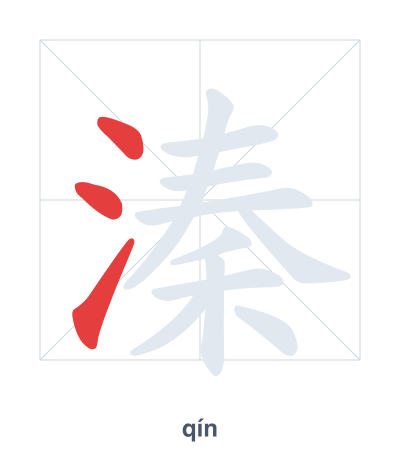
Open Hanzi Writer to see the animated stroke order and practice writing 溱 with real-time feedback.
The character 溱 (qín) is written with 13 strokes. Follow the standard Chinese stroke order: top to bottom, left to right, outside before inside. The radical 氵 is one of its key components.
Practice the correct stroke order with the Hanzi Writer app to see animated stroke-by-stroke guidance with real-time feedback.
溱 means Zhen (name of a river).
溱 is a phono-semantic compound: the water radical 氵 indicates a river, while 秦 (qín) provides the pronunciation. It refers to the Zhen River, an ancient waterway in Henan province.
💡 Memory Tip: Picture the First Emperor of Qin (秦) standing in a river (氵), declaring this waterway his own — the Zhen (溱) River.
草木溱溱。
cǎo mù qín qín
The vegetation is lush and thick.
溱水流向远方。
qín shuǐ liú xiàng yuǎn fāng
The Zhen River flows into the distance.
溱洧是两条河。
qín wěi shì liǎng tiáo hé
Zhen and Wei are two rivers.
Open Hanzi Writer to see the animated stroke order and practice writing 溱 with real-time feedback.
✨ Animated stroke order · Handwriting recognition · HSK-graded practice · Free to use
溱 is a phono-semantic compound. The left radical 氵 (water) indicates the character is related to water or a river. The right part 秦 (qín) provides the pronunciation and originally referred to the name of a region, but together they form the name of a specific river, the Zhen River.