藒 (qiè) means "a type of fragrant plant" in Chinese. It has 18 strokes with the radical 艹.
Rated 4.2/5 in difficulty (advanced).
Appears in 3+ common words including 藒车 (qiè chē), 藒草 (qiè cǎo), 藒子 (qiè zi).
Due to its 18 strokes, Hanzi Writer's error detection shows 藒 requires focused practice — most learners need 10+ attempts for consistent accuracy.
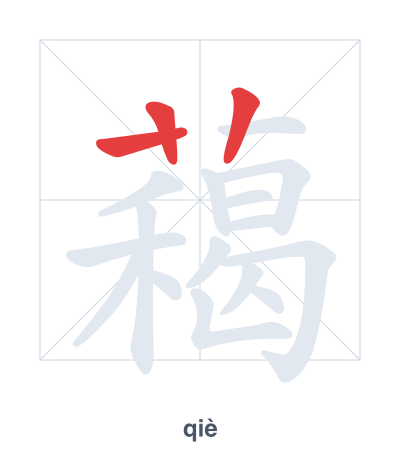
Open Hanzi Writer to see the animated stroke order and practice writing 藒 with real-time feedback.
The character 藒 (qiè) is written with 18 strokes. Follow the standard Chinese stroke order: top to bottom, left to right, outside before inside. The radical 艹 is one of its key components.
Practice the correct stroke order with the Hanzi Writer app to see animated stroke-by-stroke guidance with real-time feedback.
藒 means a type of fragrant plant.
藒 is a phono-semantic compound with the grass radical 艹 indicating it is a plant, and 曷 (hé) providing the phonetic component. The character refers specifically to a type of fragrant plant, linking the visual of grass to the notion of aroma through the sound element.
💡 Memory Tip: Imagine a fragrant plant (艹) growing where a sunbathing beggar (曷: 曰 sun + 匃 beggar) once sat, leaving behind a pleasant scent.
这种植物叫藒车。
zhè zhòng zhí wù jiào qiè chē
This plant is called Jieche herb.
藒草长在水边。
qiè cǎo zhǎng zài shuǐ biān
Qie grass grows by the water.
藒子是一种植物。
qiè zi shì yī zhǒng zhí wù
Qiezi is a type of plant.
Open Hanzi Writer to see the animated stroke order and practice writing 藒 with real-time feedback.
✨ Animated stroke order · Handwriting recognition · HSK-graded practice · Free to use
The character 藒 consists of the grass radical 艹 on top and the component 契 below. The grass radical indicates that it is a type of plant, and 契 provides a phonetic clue for the pronunciation qiè. This structure is typical for many plant names in Chinese.