茜 (qiàn) means "madder" in Chinese. It has 9 strokes with the radical 艹.
Rated 4/5 in difficulty (challenging).
Appears in 3+ common words including 茜色 (qiàn sè), 茜草 (qiàn cǎo), 茜茜 (qiàn qiàn).
Due to its 9 strokes, Hanzi Writer's error detection shows 茜 requires focused practice — most learners need 10+ attempts for consistent accuracy.
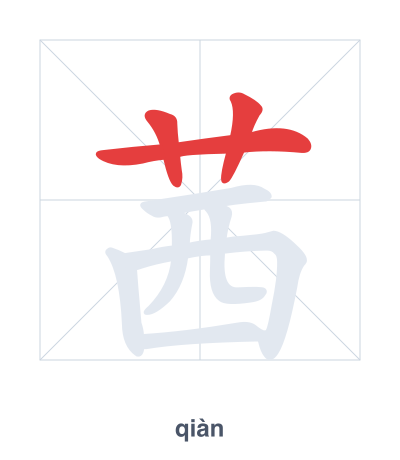
Open Hanzi Writer to see the animated stroke order and practice writing 茜 with real-time feedback.
The character 茜 (qiàn) is written with 9 strokes. Follow the standard Chinese stroke order: top to bottom, left to right, outside before inside. The radical 艹 is one of its key components.
Practice the correct stroke order with the Hanzi Writer app to see animated stroke-by-stroke guidance with real-time feedback.
茜 means madder.
This character is a phono-semantic compound. The radical 艹 (grass) indicates it is a plant, while 西 (xī) provides a phonetic clue. Madder is a perennial herb whose roots are used to produce a red dye.
💡 Memory Tip: Picture grass (艹) growing in the west (西) under a sunset that stains it madder red.
天空变成了茜色。
tiān kōng biàn chéng le qiàn sè
The sky turned a deep crimson.
茜草可以做染料。
qiàn cǎo kě yǐ zuò rǎn liào
Madder can be used as a dye.
茜茜是她的名字。
qiàn qiàn shì tā de míng zì
Sissi is her name.
Open Hanzi Writer to see the animated stroke order and practice writing 茜 with real-time feedback.
✨ Animated stroke order · Handwriting recognition · HSK-graded practice · Free to use
茜 is made of two parts: the radical 艹 (grass) on top, and 西 (west) below. The grass radical shows that 茜 is a plant (madder), while 西 gives a clue to its pronunciation (though the actual reading is qiàn, not xī). Together, the character represents the madder plant, which is used to make a red dye.