扦 (qiān) means "to prick or stick in" in Chinese. It has 6 strokes with the radical 扌.
Rated 3.2/5 in difficulty (challenging).
Appears in 3+ common words including 扦子 (qiān zi), 扦插 (qiān chā), 扦脚 (qiān jiǎo).
Due to its 6 strokes, Hanzi Writer's error detection shows 扦 requires focused practice — most learners need 10+ attempts for consistent accuracy.
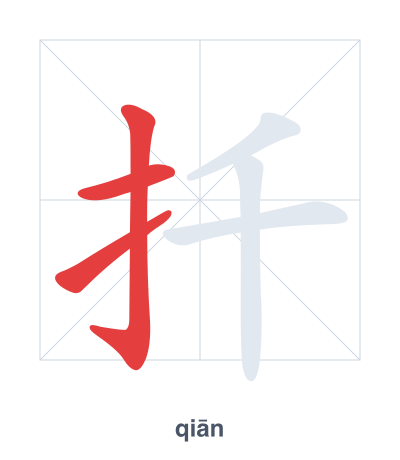
Open Hanzi Writer to see the animated stroke order and practice writing 扦 with real-time feedback.
The character 扦 (qiān) is written with 6 strokes. Follow the standard Chinese stroke order: top to bottom, left to right, outside before inside. The radical 扌 is one of its key components.
Practice the correct stroke order with the Hanzi Writer app to see animated stroke-by-stroke guidance with real-time feedback.
扦 means to prick or stick in.
扦 is a phono-semantic compound combining the hand radical 扌 (indicating an action performed by hand) with the phonetic component 千 (qiān, meaning 'thousand'). The character visually depicts a hand using a thin, pointed tool, originally referring to pricking or sticking an object into something.
💡 Memory Tip: Picture a hand (扌) holding a long, pointed stick shaped like the character 千, using it to prick a surface.
羊肉串在扦子上。
yáng ròu chuàn zài qiān zi shàng
The mutton skewers are on the skewers.
这种花可以扦插。
zhè zhòng huā kě yǐ qiān chā
This flower can be grown from cuttings.
他去店里扦脚。
tā qù diàn lǐ qiān jiǎo
He went to the shop for a pedicure.
Open Hanzi Writer to see the animated stroke order and practice writing 扦 with real-time feedback.
✨ Animated stroke order · Handwriting recognition · HSK-graded practice · Free to use
The left radical 扌 (hand) indicates a hand action. The right side 千 (qiān) gives the pronunciation and also suggests 'thousand' — you can imagine a hand using a thin rod with many points. Together they mean to prick or stick in, like using a skewer.