芑 (qǐ) means "White millet" in Chinese. It has 6 strokes with the radical 艹.
Rated 3.2/5 in difficulty (challenging).
Appears in 3+ common words including 白芑 (bái qǐ), 芑实 (qǐ shí), 芑菜 (qǐ cài).
Due to its 6 strokes, Hanzi Writer's error detection shows 芑 requires focused practice — most learners need 10+ attempts for consistent accuracy.
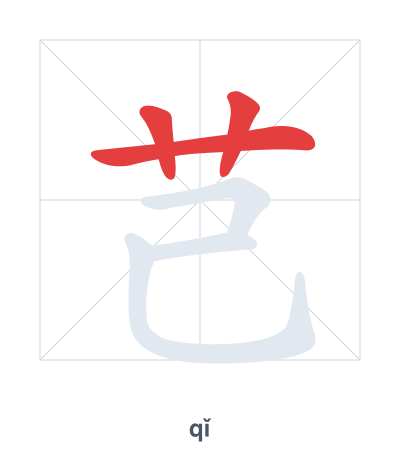
Open Hanzi Writer to see the animated stroke order and practice writing 芑 with real-time feedback.
The character 芑 (qǐ) is written with 6 strokes. Follow the standard Chinese stroke order: top to bottom, left to right, outside before inside. The radical 艹 is one of its key components.
Practice the correct stroke order with the Hanzi Writer app to see animated stroke-by-stroke guidance with real-time feedback.
芑 means White millet.
芑 is a compound character with the radical 艹 (grass) indicating it is a plant, and 己 (self) providing phonetic and perhaps visual cues to a specific type of millet with white grains. The ancient form likely depicted a stalk of millet, with the top part representing the plant and the lower part suggesting its grain-bearing stem.
💡 Memory Tip: Picture a grassy plant (艹) whose coiled stalk (己) is full of tiny white millet seeds, like a self-contained bundle of grain.
白芑可以吃。
bái qǐ kě yǐ chī
White endive is edible.
这是芑实。
zhè shì qǐ shí
This is the fruit of the white millet.
芑菜很新鲜。
qǐ cài hěn xīn xiān
The sow thistle is very fresh.
Open Hanzi Writer to see the animated stroke order and practice writing 芑 with real-time feedback.
✨ Animated stroke order · Handwriting recognition · HSK-graded practice · Free to use
芑 is composed of the radical 艹 (grass) on top and 己 (jǐ, self) below. The grass radical indicates it is a plant, while 己 provides pronunciation clues. Together they represent a type of grass or grain: white millet.