萋 (qī) means "luxuriant; lush" in Chinese. It has 11 strokes with the radical 艹.
Rated 4.2/5 in difficulty (advanced).
Appears in 3+ common words including 萋萋 (qī qī), 芳草萋萋 (fāng cǎo qī qī), 萋斐 (qī fěi).
Due to its 11 strokes, Hanzi Writer's error detection shows 萋 requires focused practice — most learners need 10+ attempts for consistent accuracy.
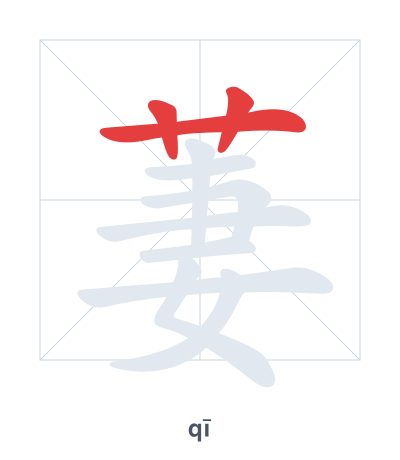
Open Hanzi Writer to see the animated stroke order and practice writing 萋 with real-time feedback.
The character 萋 (qī) is written with 11 strokes. Follow the standard Chinese stroke order: top to bottom, left to right, outside before inside. The radical 艹 is one of its key components.
Practice the correct stroke order with the Hanzi Writer app to see animated stroke-by-stroke guidance with real-time feedback.
萋 means luxuriant; lush.
萋 is a phono-semantic compound: the grass radical (艹) indicates lush vegetation, while 妻 (wife, qī) provides the pronunciation. The combination suggests grass growing as thickly and densely as a wife's hair or a family's abundance.
💡 Memory Tip: Picture a wife (妻) relaxing in a field of grass (艹) so lush that it almost hides her completely.
绿草萋萋。
lǜ cǎo qī qī
The green grass is lush and thick.
郊外芳草萋萋。
jiāo wài fāng cǎo qī qī
The grass is lush and green in the countryside.
文章辞采萋斐。
wén zhāng cí cǎi qī fěi
The article's language is elegant and brilliant.
Open Hanzi Writer to see the animated stroke order and practice writing 萋 with real-time feedback.
✨ Animated stroke order · Handwriting recognition · HSK-graded practice · Free to use
萋 is composed of the radical 艹 (grass) on top, and 妻 (wife) below. The grass radical directly connects to its meaning of lush vegetation. The lower part 妻 provides the pronunciation qī and may suggest the idea of something spreading or covering, like grass over a landscape.