滂 (pāng) means "torrential; vast" in Chinese. It has 13 strokes with the radical 氵.
Rated 4.2/5 in difficulty (advanced).
Appears in 3+ common words including 滂沱 (pāng tuó), 滂沛 (pāng pèi), 滂渤 (pāng bó).
Due to its 13 strokes, Hanzi Writer's error detection shows 滂 requires focused practice — most learners need 10+ attempts for consistent accuracy.
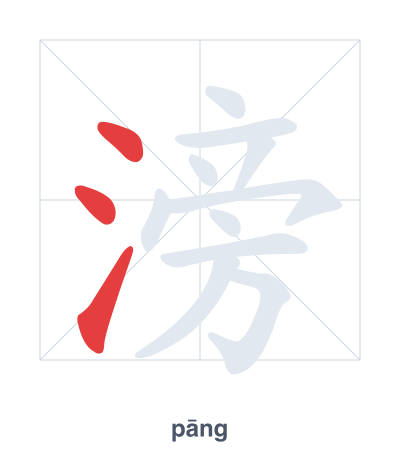
Open Hanzi Writer to see the animated stroke order and practice writing 滂 with real-time feedback.
The character 滂 (pāng) is written with 13 strokes. Follow the standard Chinese stroke order: top to bottom, left to right, outside before inside. The radical 氵 is one of its key components.
Practice the correct stroke order with the Hanzi Writer app to see animated stroke-by-stroke guidance with real-time feedback.
滂 means torrential; vast.
滂 is a phono-semantic compound: the radical 氵 (water) indicates it relates to water, while the component 旁 (páng, meaning 'side' or 'beside') provides the pronunciation and suggests water spreading sideways. Together, they evoke the image of water overflowing its boundaries, creating a vast, torrential flow.
💡 Memory Tip: Imagine a massive wave crashing sideways (旁) with such force that water (氵) explodes everywhere in a torrential flood.
外面下着滂沱大雨。
wài miàn xià zhe pāng tuó dà yǔ
It is pouring rain outside.
雨势滂沛,无法出门。
yǔ shì pāng pèi wú fǎ chū mén
The rain is pouring down so hard that I can't go out.
水势滂渤,非常壮观。
shuǐ shì pāng bó fēi cháng zhuàng guān
The water flow is surging and very spectacular.
Open Hanzi Writer to see the animated stroke order and practice writing 滂 with real-time feedback.
✨ Animated stroke order · Handwriting recognition · HSK-graded practice · Free to use
滂 is composed of the water radical 氵 on the left, which hints at water or liquid, and the phonetic component 旁 on the right, which suggests the sound "páng". Together, they create the idea of water spreading widely, giving the meaning of torrential or vast, especially for rain.