拚 (pàn) means "To risk one's life / to go all out" in Chinese. It has 8 strokes with the radical 扌.
Rated 3.7/5 in difficulty (challenging).
Appears in 3+ common words including 拚命 (pàn mìng), 拚搏 (pàn bó), 拚死 (pàn sǐ).
Due to its 8 strokes, Hanzi Writer's error detection shows 拚 requires focused practice — most learners need 10+ attempts for consistent accuracy.
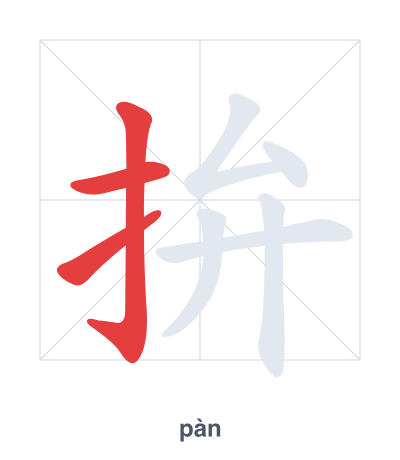
Open Hanzi Writer to see the animated stroke order and practice writing 拚 with real-time feedback.
The character 拚 (pàn) is written with 8 strokes. Follow the standard Chinese stroke order: top to bottom, left to right, outside before inside. The radical 扌 is one of its key components.
Practice the correct stroke order with the Hanzi Writer app to see animated stroke-by-stroke guidance with real-time feedback.
拚 means To risk one's life / to go all out.
拚 is a compound of 扌 (hand) and 弁 (an ancient ceremonial cap). The hand adjusting a cap symbolizes preparing for a serious event, which evolved to mean risking one's life or going all out in an endeavor.
💡 Memory Tip: Imagine a hand (扌) placing a cap (弁) on your head as you brace yourself to charge into danger with all your might.
他在拚命工作。
tā zài pàn mìng gōng zuò
He is working desperately hard.
运动员努力拚搏。
yùn dòng yuán nǔ lì pàn bó
Athletes strive hard.
他拚死保护孩子。
tā pàn sǐ bǎo hù hái zi
He risked his life to protect the child.
Open Hanzi Writer to see the animated stroke order and practice writing 拚 with real-time feedback.
✨ Animated stroke order · Handwriting recognition · HSK-graded practice · Free to use
The character 拚 is a left-right structure. The left side is 扌, the hand radical, indicating that the meaning involves an action. The right side is 弁, which originally meant a cap but here suggests putting something aside or distinguishing; together, the hand and the idea of setting aside create the meaning of "to risk one's life" or "to go all out."