藕 (ǒu) means "lotus root" in Chinese. It has 18 strokes with the radical 艹.
Rated 4.2/5 in difficulty (advanced).
Appears in 3+ common words including 莲藕 (lián ǒu), 藕粉 (ǒu fěn), 藕断丝连 (ǒu duàn sī lián).
Due to its 18 strokes, Hanzi Writer's error detection shows 藕 requires focused practice — most learners need 10+ attempts for consistent accuracy.
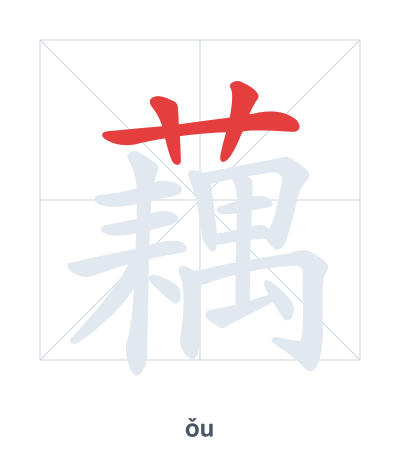
Open Hanzi Writer to see the animated stroke order and practice writing 藕 with real-time feedback.
The character 藕 (ǒu) is written with 18 strokes. Follow the standard Chinese stroke order: top to bottom, left to right, outside before inside. The radical 艹 is one of its key components.
Practice the correct stroke order with the Hanzi Writer app to see animated stroke-by-stroke guidance with real-time feedback.
藕 means lotus root.
藕 (ǒu) is a phono-semantic compound: the radical 艹 (grass/plant) indicates it's a vegetable, while the phonetic component 耦 (ǒu) originally meant 'a pair of plowing oxen' and hints at the lotus root's segmented, paired nodes.
💡 Memory Tip: Picture a lotus root with two segments (耦) sprouting from mud under a grassy plant (艹), like a hidden vegetable pair waiting to be unearthed.
莲藕是一种蔬菜。
lián ǒu shì yī zhǒng shū cài
Lotus root is a type of vegetable.
我早餐喝藕粉。
wǒ zǎo cān hē ǒu fěn
I have lotus root starch for breakfast.
他们依然藕断丝连。
tā men yī rán ǒu duàn sī lián
They are still lingeringly attached to each other.
Open Hanzi Writer to see the animated stroke order and practice writing 藕 with real-time feedback.
✨ Animated stroke order · Handwriting recognition · HSK-graded practice · Free to use
藕 has the radical 艹 (grass/plant) on top, indicating it is a plant. The bottom part 偶 (ǒu) provides the pronunciation and hints at the plant's name. Together, the character represents the lotus root, an edible plant stem.