坭 (ní) means "mud / clay" in Chinese. It has 8 strokes with the radical 土.
Rated 3.7/5 in difficulty (challenging).
Appears in 3+ common words including 坭土 (ní tǔ), 坭兴陶 (ní xīng táo), 坭坑 (ní kēng).
Due to its 8 strokes, Hanzi Writer's error detection shows 坭 requires focused practice — most learners need 10+ attempts for consistent accuracy.
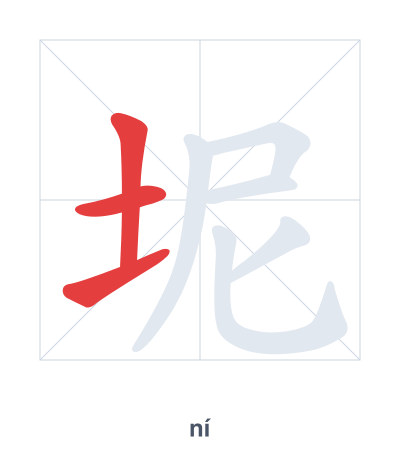
Open Hanzi Writer to see the animated stroke order and practice writing 坭 with real-time feedback.
The character 坭 (ní) is written with 8 strokes. Follow the standard Chinese stroke order: top to bottom, left to right, outside before inside. The radical 土 is one of its key components.
Practice the correct stroke order with the Hanzi Writer app to see animated stroke-by-stroke guidance with real-time feedback.
坭 means mud / clay.
坭 is a compound character combining the radical 土 (earth) with the phonetic component 尼 (ní, which originally depicted a person sitting). The earth radical indicates that the meaning relates to soil, while the phonetic suggests the pronunciation, resulting in the meaning 'mud' or 'clay.'
💡 Memory Tip: Picture a person (尼) sinking into a patch of wet earth (土) up to their knees—that sticky, gooey mess is 坭 (mud).
鞋上沾满了坭土。
xié shàng zhān mǎn le ní tǔ
The shoes are covered in mud.
坭兴陶是中国名陶。
ní xīng táo shì zhōng guó míng táo
Nixing pottery is a famous Chinese pottery.
车轮陷进了坭坑里。
chē lún xiàn jìn le ní kēng lǐ
The wheel got stuck in a mud pit.
Open Hanzi Writer to see the animated stroke order and practice writing 坭 with real-time feedback.
✨ Animated stroke order · Handwriting recognition · HSK-graded practice · Free to use
坭 is composed of the radical 土 (earth) on the left and 尼 (ní, phonetic component) on the right. The radical 土 directly suggests mud or clay, which is the meaning of the character. The right part 尼 provides the pronunciation but does not contribute to the meaning.