倪 (ní) means "surname Ni / limit / origin" in Chinese. It has 10 strokes with the radical 人.
Rated 3.9/5 in difficulty (challenging).
Appears in 2+ common words including 端倪 (duān ní), 倪 (ní).
Due to its 10 strokes, Hanzi Writer's error detection shows 倪 requires focused practice — most learners need 10+ attempts for consistent accuracy.
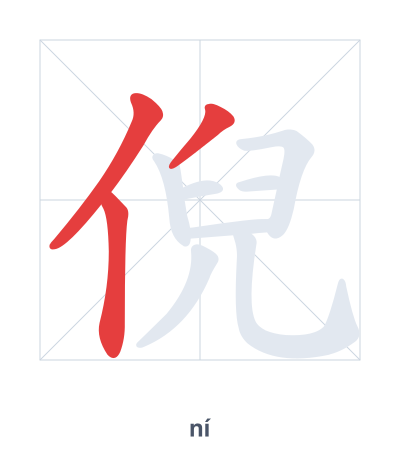
Open Hanzi Writer to see the animated stroke order and practice writing 倪 with real-time feedback.
The character 倪 (ní) is written with 10 strokes. Follow the standard Chinese stroke order: top to bottom, left to right, outside before inside. The radical 人 is one of its key components.
Practice the correct stroke order with the Hanzi Writer app to see animated stroke-by-stroke guidance with real-time feedback.
倪 means surname Ni / limit / origin.
倪 is a phono-semantic compound where the left radical 亻 suggests a person, and the right component 兒 (child, pronounced ní) provides the sound. Its original meaning, 'limit' or 'boundary,' may have evolved from the idea of a person drawing a line around a child's area of play.
💡 Memory Tip: Imagine a person (亻) setting a limit by placing a tiny child (兒) inside a circle—the child's small size defines the boundary.
事情终于露出了端倪。
shì qíng zhōng yú lù chū le duān ní
The matter has finally begun to show signs of a clue.
他姓倪。
tā xìng ní
His surname is Ni.
倪是一个常见的姓氏。
ní shì yí gè cháng jiàn de xìng shì
'Ni' is a common surname.
Open Hanzi Writer to see the animated stroke order and practice writing 倪 with real-time feedback.
✨ Animated stroke order · Handwriting recognition · HSK-graded practice · Free to use
倪 is made of the person radical 亻 on the left and 兒 on the right. 兒 originally meant "child" and gives the sound ní, while the person radical suggests a human connection. The meaning "limit" or "origin" came from extended use, not directly from the components.