沐 (mù) means "to bathe; to wash; to receive" in Chinese. It has 7 strokes with the radical 氵, and is HSK Level 7.
Rated 3.5/5 in difficulty (challenging).
Harder than 19% of HSK Level 7 characters.
Appears in 3+ common words including 沐浴 (mù yù), 沐浴露 (mù yù lù), 沐浴阳光 (mù yù yáng guāng).
Due to its 7 strokes, Hanzi Writer's error detection shows 沐 requires focused practice — most learners need 10+ attempts for consistent accuracy.
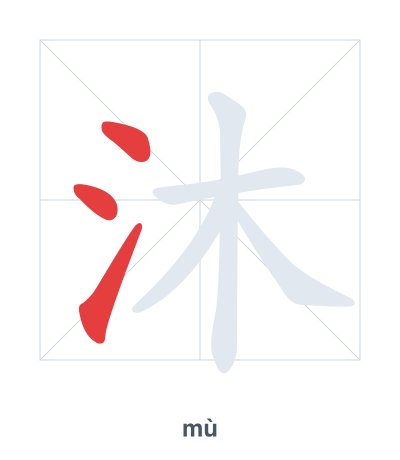
Open Hanzi Writer to see the animated stroke order and practice writing 沐 with real-time feedback.
The character 沐 (mù) is written with 7 strokes. Follow the standard Chinese stroke order: top to bottom, left to right, outside before inside. The radical 氵 is one of its key components.
Practice the correct stroke order with the Hanzi Writer app to see animated stroke-by-stroke guidance with real-time feedback.
沐 means to bathe; to wash; to receive.
As an HSK Level 7 character, 沐 is an intermediate-level character.
沐 is a phono-semantic compound: the water radical (氵) conveys the meaning of washing, while 木 (tree, mù) provides the pronunciation. Its original sense was to wash one's hair, which was often done outdoors using water and a tree for support or a wooden basin.
💡 Memory Tip: Imagine a tree (木) standing under a shower of water (氵) as if taking a bath.
他正在沐浴。
tā zhèng zài mù yù
He is taking a bath.
这个沐浴露很香。
zhè ge mù yù lù hěn xiāng
This body wash smells very good.
我们在沐浴阳光。
wǒ men zài mù yù yáng guāng
We are basking in the sun.
Open Hanzi Writer to see the animated stroke order and practice writing 沐 with real-time feedback.
✨ Animated stroke order · Handwriting recognition · HSK-graded practice · Free to use
沐 is made of two parts: the left side 氵 (water radical) and the right side 木 (wood/tree). The water radical suggests the action of washing or bathing, while 木 gives the character its pronunciation mù. Together, they create the meaning "to bathe" or "to wash with water."