眸 (móu) means "pupil of the eye" in Chinese. It has 11 strokes with the radical 目.
Rated 4.2/5 in difficulty (advanced).
Appears in 3+ common words including 眸子 (móu zi), 明眸 (míng móu), 回眸 (huí móu).
Due to its 11 strokes, Hanzi Writer's error detection shows 眸 requires focused practice — most learners need 10+ attempts for consistent accuracy.
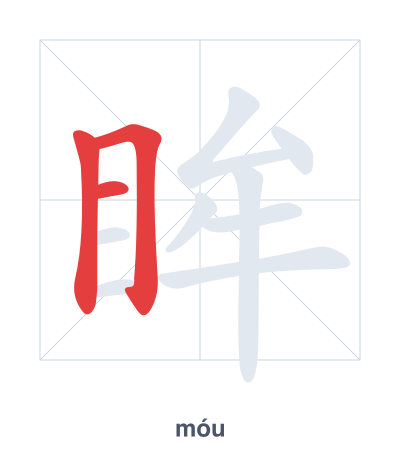
Open Hanzi Writer to see the animated stroke order and practice writing 眸 with real-time feedback.
The character 眸 (móu) is written with 11 strokes. Follow the standard Chinese stroke order: top to bottom, left to right, outside before inside. The radical 目 is one of its key components.
Practice the correct stroke order with the Hanzi Writer app to see animated stroke-by-stroke guidance with real-time feedback.
眸 means pupil of the eye.
眸 is a phono-semantic compound: the radical 目 (eye) indicates the meaning relates to the eye, while 牟 (móu) provides the pronunciation. It specifically refers to the pupil, the dark central opening of the eye through which light enters.
💡 Memory Tip: Picture an eye (目) gazing at a cow (牟), and the cow's dark pupil stares right back — that's 眸.
她的眸子很明亮。
tā de móu zi hěn míng liàng
Her eyes are very bright.
她有一双明眸。
tā yǒu yī shuāng míng móu
She has bright eyes.
她对他回眸一笑。
tā duì tā huí móu yī xiào
She looked back and smiled at him.
Open Hanzi Writer to see the animated stroke order and practice writing 眸 with real-time feedback.
✨ Animated stroke order · Handwriting recognition · HSK-graded practice · Free to use
眸 is composed of the radical 目 (eye) on the left and the phonetic component 牟 on the right. The radical 目 directly indicates that the character relates to the eye, while 牟 provides pronunciation (móu). Together, they form a character meaning 'pupil of the eye' or simply 'eye'.