冕 (miǎn) means "Ceremonial crown" in Chinese. It has 11 strokes with the radical 冂.
Rated 3.9/5 in difficulty (challenging).
Appears in 3+ common words including 卫冕 (wèi miǎn), 冠冕 (guān miǎn), 冕 (miǎn).
Due to its 11 strokes, Hanzi Writer's error detection shows 冕 requires focused practice — most learners need 10+ attempts for consistent accuracy.
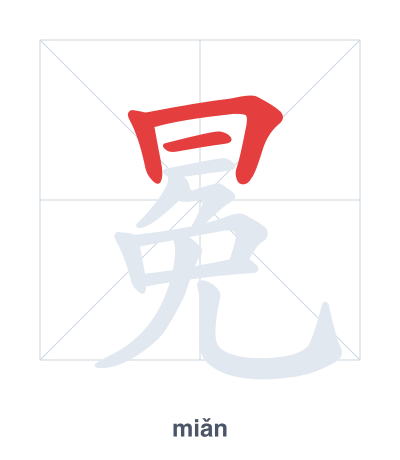
Open Hanzi Writer to see the animated stroke order and practice writing 冕 with real-time feedback.
The character 冕 (miǎn) is written with 11 strokes. Follow the standard Chinese stroke order: top to bottom, left to right, outside before inside. The radical 冂 is one of its key components.
Practice the correct stroke order with the Hanzi Writer app to see animated stroke-by-stroke guidance with real-time feedback.
冕 means Ceremonial crown.
| Character | 冕 |
| Pinyin | miǎn (mian) |
| Meaning | Ceremonial crown |
| Strokes | 11 |
| Radical | 冂 |
| Difficulty | 3.9/5 |
The character 冕 depicts a ceremonial crown with a wide brim. The top component 冂 represents the brim of the crown, while the lower part 免 originally showed a person wearing a cap with ear flaps, together symbolizing the formal headgear of a ruler. Over time, the shape simplified but retained the sense of a majestic headdress used in rituals.
💡 Memory Tip: Picture a king wearing a wide-brimmed crown (冂) that makes him 'exempt' (免) from ever bowing or removing it – it's the ultimate ceremonial headgear.
他想卫冕冠军。
tā xiǎng wèi miǎn guàn jūn
He wants to defend his championship title.
话不要说得太冠冕。
huà bú yào shuō dé tài guān miǎn
Don't speak too pompously.
这是一个王冠。
zhè shì yí gè wáng guān
This is a crown.
Open Hanzi Writer to see the animated stroke order and practice writing 冕 with real-time feedback.
✨ Animated stroke order · Handwriting recognition · HSK-graded practice · Free to use
The character 冕 is made of the radical 冂 (wide enclosure) on top and 免 below. The top part 冂 represents the shape of a crown or headband, while 免 provides the pronunciation and originally showed a person wearing a head covering. Together they form the meaning of a ceremonial crown worn by ancient rulers.