洣 (mǐ) means "Mi (name of a river)" in Chinese. It has 9 strokes with the radical 氵.
Rated 4/5 in difficulty (challenging).
Appears in 3+ common words including 洣水 (mǐ shuǐ), 洣江 (mǐ jiāng), 洣河 (mǐ hé).
Due to its 9 strokes, Hanzi Writer's error detection shows 洣 requires focused practice — most learners need 10+ attempts for consistent accuracy.
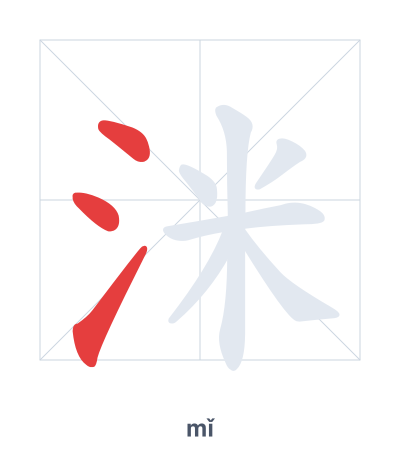
Open Hanzi Writer to see the animated stroke order and practice writing 洣 with real-time feedback.
The character 洣 (mǐ) is written with 9 strokes. Follow the standard Chinese stroke order: top to bottom, left to right, outside before inside. The radical 氵 is one of its key components.
Practice the correct stroke order with the Hanzi Writer app to see animated stroke-by-stroke guidance with real-time feedback.
洣 means Mi (name of a river).
洣 is a phono-semantic compound: the water radical (氵) indicates it's a river name, while 米 (rice) provides the pronunciation (mǐ). The character literally means 'Mi River', likely named after rice cultivation along its banks.
💡 Memory Tip: Picture a river (氵) where grains of rice (米) float downstream like tiny boats.
洣水流过这个村庄。
mǐ shuǐ liú guò zhè ge cūn zhuāng
The Mi River flows through this village.
洣江的风景很美。
mǐ jiāng de fēng jǐng hěn měi
The scenery of the Mi River is very beautiful.
我们去洣河钓鱼吧。
wǒ men qù mǐ hé diào yú ba
Let's go fishing in the Mi River.
Open Hanzi Writer to see the animated stroke order and practice writing 洣 with real-time feedback.
✨ Animated stroke order · Handwriting recognition · HSK-graded practice · Free to use
洣 is made of the water radical 氵 on the left and the character 米 (mǐ, meaning rice) on the right. The water radical shows it relates to a river or water, and 米 provides the pronunciation mǐ. Together, they form the name of a specific river, the Mi River, without a direct meaning connection to rice.