袮 (mí) means "You (archaic variant) or ancestral temple" in Chinese. It has 10 strokes with the radical 衤.
Rated 4.2/5 in difficulty (advanced).
Appears in 3+ common words including 袮豆子 (mí dòu zi), 袮衡 (mí héng), 袮字 (mí zì).
Due to its 10 strokes, Hanzi Writer's error detection shows 袮 requires focused practice — most learners need 10+ attempts for consistent accuracy.
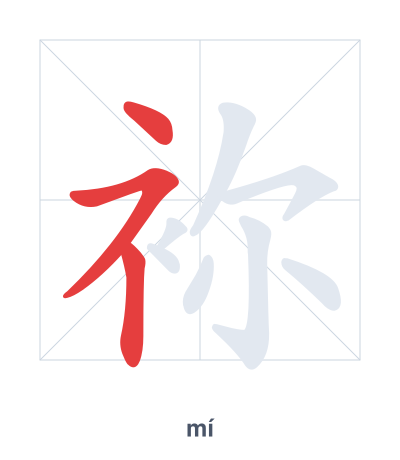
Open Hanzi Writer to see the animated stroke order and practice writing 袮 with real-time feedback.
The character 袮 (mí) is written with 10 strokes. Follow the standard Chinese stroke order: top to bottom, left to right, outside before inside. The radical 衤 is one of its key components.
Practice the correct stroke order with the Hanzi Writer app to see animated stroke-by-stroke guidance with real-time feedback.
袮 means You (archaic variant) or ancestral temple.
This character combines the radical 衤 (clothing) with 尔 (you/phonetic). It is an archaic variant of 祢, originally written with the altar radical 示 to denote 'ancestral temple' or 'you' (as a respectful address). The shift to the clothing radical likely arose from phonetic borrowing or scribal variation, using the sound of 尔 to represent the word for 'you' while retaining a visual hint of ceremonial garments.
💡 Memory Tip: Imagine a sacred garment (衤) embroidered with the word 'you' (尔), worn by an ancestor in the temple to remind you whom you are addressing.
我喜欢袮豆子。
wǒ xǐ huān mí dòu zi
I like Nezuko.
袮衡是古代的名人。
mí héng shì gǔ dài de míng rén
Ni Heng was a famous person in ancient times.
这个字读作mí。
zhè ge zì dú zuò mí。
This character is pronounced 'mí'.
Open Hanzi Writer to see the animated stroke order and practice writing 袮 with real-time feedback.
✨ Animated stroke order · Handwriting recognition · HSK-graded practice · Free to use
袮 is composed of the radical 衤 (clothing) on the left and 尔 (you) on the right. The radical suggests a connection to clothing or fabric, while 尔 provides the phonetic and ancient meaning of 'you'. Together, the character originally referred to an ancestral temple garment, but later became an archaic variant for 'you'.