焖 (mèn) means "to braise / to stew" in Chinese. It has 11 strokes with the radical 火.
Rated 4.2/5 in difficulty (advanced).
Appears in 3+ common words including 黄焖鸡 (huáng mèn jī), 焖饭 (mèn fàn), 焖肉 (mèn ròu).
Due to its 11 strokes, Hanzi Writer's error detection shows 焖 requires focused practice — most learners need 10+ attempts for consistent accuracy.
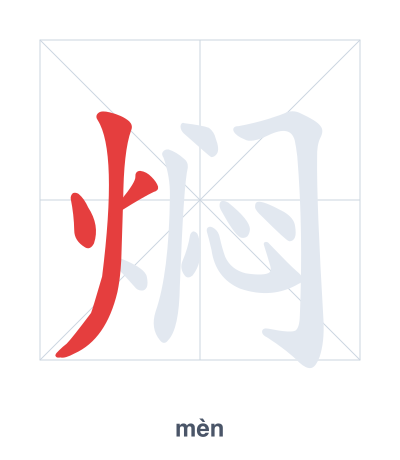
Open Hanzi Writer to see the animated stroke order and practice writing 焖 with real-time feedback.
The character 焖 (mèn) is written with 11 strokes. Follow the standard Chinese stroke order: top to bottom, left to right, outside before inside. The radical 火 is one of its key components.
Practice the correct stroke order with the Hanzi Writer app to see animated stroke-by-stroke guidance with real-time feedback.
焖 means to braise / to stew.
焖 combines the radical 火 (fire) with 闷 (mèn, meaning 'stuffy' or 'enclosed'). The fire component represents heat, while 闷 suggests a covered cooking vessel that traps steam and heat, which is the essence of braising or stewing.
💡 Memory Tip: Picture a fire (火) under a closed pot with a heart inside (心) that feels stuffy from trapped steam—that's how you 焖 (braise) your meal.
我午饭想吃黄焖鸡。
wǒ wǔ fàn xiǎng chī huáng mèn jī
I want to eat braised chicken for lunch.
锅里正在焖饭。
guō lǐ zhèng zài mèn fàn
Rice is being simmered in the pot.
焖肉的味道非常香。
mèn ròu de wèi dào fēi cháng xiāng
The braised meat smells very delicious.
Open Hanzi Writer to see the animated stroke order and practice writing 焖 with real-time feedback.
✨ Animated stroke order · Handwriting recognition · HSK-graded practice · Free to use
The character 焖 combines the radical 火 (fire) on the left with the phonetic component 闷 (mèn, meaning stuffy or confined) on the right. The fire radical suggests heat, while 闷 implies a closed or sealed environment, together describing the cooking method of braising food in a covered pot with steam and heat.