楣 (méi) means "lintel / crossbeam" in Chinese. It has 13 strokes with the radical 木.
Rated 4.2/5 in difficulty (advanced).
Appears in 3+ common words including 门楣 (mén méi), 光耀门楣 (guāng yào mén méi), 楣梁 (méi liáng).
Due to its 13 strokes, Hanzi Writer's error detection shows 楣 requires focused practice — most learners need 10+ attempts for consistent accuracy.
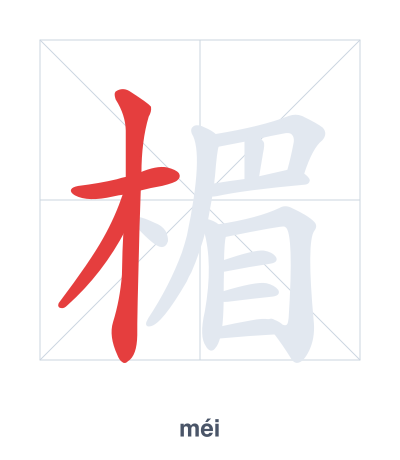
Open Hanzi Writer to see the animated stroke order and practice writing 楣 with real-time feedback.
The character 楣 (méi) is written with 13 strokes. Follow the standard Chinese stroke order: top to bottom, left to right, outside before inside. The radical 木 is one of its key components.
Practice the correct stroke order with the Hanzi Writer app to see animated stroke-by-stroke guidance with real-time feedback.
楣 means lintel / crossbeam.
楣 is a phono-semantic compound: the radical 木 (wood) indicates the material, and the phonetic component 眉 (méi, 'eyebrow') also hints at the position above an opening, just as eyebrows sit above the eyes. The lintel is the horizontal crossbeam over a door or window, supporting the wall above.
💡 Memory Tip: Imagine a wooden beam (木) with a giant eyebrow (眉) arched over a doorway—the 'eyebrow of the door' is the lintel.
门楣上挂着红灯笼。
mén méi shàng guà zhe hóng dēng lóng
Red lanterns are hanging on the lintel.
他想努力光耀门楣。
tā xiǎng nǔ lì guāng yào mén méi
He wants to work hard to bring honor to his family.
这里的楣梁很高。
zhè lǐ de méi liáng hěn gāo
The lintels here are very high.
Open Hanzi Writer to see the animated stroke order and practice writing 楣 with real-time feedback.
✨ Animated stroke order · Handwriting recognition · HSK-graded practice · Free to use
楣 is made of two parts: the left radical 木 (wood) and the right component 眉 (eyebrow). Since a lintel is a wooden beam above a door, the "wood" radical shows the material, and "eyebrow" suggests its position above the door, like an eyebrow above an eye.