泖 (mǎo) means "Mao (a name for a river or lake)" in Chinese. It has 8 strokes with the radical 氵.
Rated 3.7/5 in difficulty (challenging).
Appears in 3+ common words including 泖河 (mǎo hé), 泖湖 (mǎo hú), 泖港 (mǎo gǎng).
Due to its 8 strokes, Hanzi Writer's error detection shows 泖 requires focused practice — most learners need 10+ attempts for consistent accuracy.
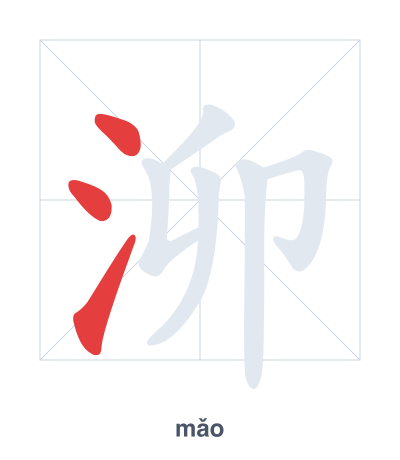
Open Hanzi Writer to see the animated stroke order and practice writing 泖 with real-time feedback.
The character 泖 (mǎo) is written with 8 strokes. Follow the standard Chinese stroke order: top to bottom, left to right, outside before inside. The radical 氵 is one of its key components.
Practice the correct stroke order with the Hanzi Writer app to see animated stroke-by-stroke guidance with real-time feedback.
泖 means Mao (a name for a river or lake).
This character is a phono-semantic compound where the water radical (氵) indicates its connection to rivers and lakes, while the phonetic component 卯 (mǎo) provides the sound. It is used specifically as a place name for certain water bodies, such as Lake Mao in China.
💡 Memory Tip: Picture a lake (氵) with two horned water monsters (the shape of 卯) named Mao swimming in it.
泖河的水很清。
mǎo hé de shuǐ hěn qīng
The water in the Mao River is very clear.
泖湖在上海。
mǎo hú zài shàng hǎi
Mao Lake is in Shanghai.
泖港是一个小镇。
mǎo gǎng shì yí gè xiǎo zhèn
Maogang is a small town.
Open Hanzi Writer to see the animated stroke order and practice writing 泖 with real-time feedback.
✨ Animated stroke order · Handwriting recognition · HSK-graded practice · Free to use
The left component 氵 (water radical) indicates the character relates to water. The right component 卯 (mǎo) provides the pronunciation and is a phonetic hint, not directly linked to meaning. Together, 泖 is used as a proper name for certain rivers or lakes, like 泖河.