锣 (luó) means "Gong" in Chinese. It has 13 strokes with the radical 钅.
Rated 4.2/5 in difficulty (advanced).
Appears in 3+ common words including 敲锣 (qiāo luó), 锣鼓 (luó gǔ), 铜锣 (tóng luó).
Due to its 13 strokes, Hanzi Writer's error detection shows 锣 requires focused practice — most learners need 10+ attempts for consistent accuracy.
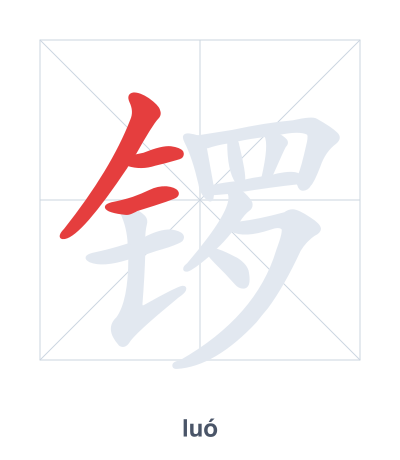
Open Hanzi Writer to see the animated stroke order and practice writing 锣 with real-time feedback.
The character 锣 (luó) is written with 13 strokes. Follow the standard Chinese stroke order: top to bottom, left to right, outside before inside. The radical 钅 is one of its key components.
Practice the correct stroke order with the Hanzi Writer app to see animated stroke-by-stroke guidance with real-time feedback.
锣 means Gong.
锣 combines the radical 钅 (metal), indicating the material, with 罗 (luó), which provides the phonetic hint. It refers to a metal percussion instrument, the gong, traditionally made of bronze.
💡 Memory Tip: Picture a metal (钅) gong shaped like a net (罗) that catches and amplifies sound waves.
运动员在敲锣。
yùn dòng yuán zài qiāo luó
Athletes are hitting the gongs.
锣鼓声很大。
luó gǔ shēng hěn dà
The sound of gongs and drums is very loud.
这是一个大铜锣。
zhè shì yí gè dà tóng luó
This is a large bronze gong.
Open Hanzi Writer to see the animated stroke order and practice writing 锣 with real-time feedback.
✨ Animated stroke order · Handwriting recognition · HSK-graded practice · Free to use
The character 锣 is composed of the radical 钅 on the left, meaning 'metal', and the phonetic component 罗 on the right, which gives the sound 'luó'. Since a gong is a metal percussion instrument, the metal radical directly links to its material, while the phonetic part shows how to pronounce it.