舻 (lú) means "Stern; oar" in Chinese. It has 11 strokes with the radical 舟.
Rated 4.2/5 in difficulty (advanced).
Appears in 3+ common words including 舳舻 (zhú lú), 船舻 (chuán lú), 舻声 (lú shēng).
Due to its 11 strokes, Hanzi Writer's error detection shows 舻 requires focused practice — most learners need 10+ attempts for consistent accuracy.
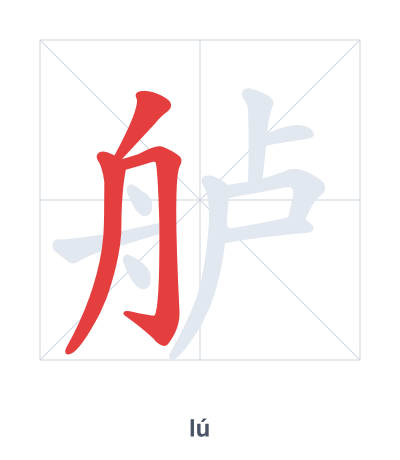
Open Hanzi Writer to see the animated stroke order and practice writing 舻 with real-time feedback.
The character 舻 (lú) is written with 11 strokes. Follow the standard Chinese stroke order: top to bottom, left to right, outside before inside. The radical 舟 is one of its key components.
Practice the correct stroke order with the Hanzi Writer app to see animated stroke-by-stroke guidance with real-time feedback.
舻 means Stern; oar.
舻 is a phono-semantic compound. The radical 舟 (boat) indicates the meaning relates to boats, while 卢 (lú) provides the sound. Historically, 舻 refers to the stern of a ship or an oar used for steering.
💡 Memory Tip: Picture a boat (舟) with a huge oar at the stern shaped like a small hut (卢), where the rower sits to steer the vessel.
江上舳舻相接。
jiāng shàng zhú lú xiāng jiē
Ships follow one after another on the river.
船舻在水中前进。
chuán lú zài shuǐ zhōng qián jìn
The ship's stern moves forward in the water.
远处传来舻声。
yuǎn chù chuán lái lú shēng
The sound of oars came from the distance.
Open Hanzi Writer to see the animated stroke order and practice writing 舻 with real-time feedback.
✨ Animated stroke order · Handwriting recognition · HSK-graded practice · Free to use
舻 consists of the radical 舟 (boat) on the left and the phonetic component 卢 (lú) on the right. The 舟 part directly connects to the meaning 'boat', while 卢 provides the sound and hints at the stern or oar parts of a vessel.