舳 (zhú) means "stern (of a boat)" in Chinese. It has 11 strokes with the radical 舟.
Rated 4.2/5 in difficulty (advanced).
Appears in 3+ common words including 舳舻 (zhú lú), 船舳 (chuán zhú), 舳板 (zhú bǎn).
Due to its 11 strokes, Hanzi Writer's error detection shows 舳 requires focused practice — most learners need 10+ attempts for consistent accuracy.
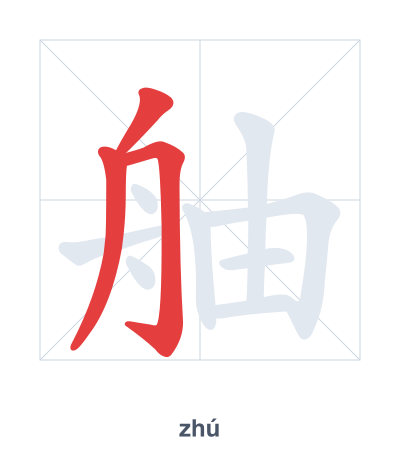
Open Hanzi Writer to see the animated stroke order and practice writing 舳 with real-time feedback.
The character 舳 (zhú) is written with 11 strokes. Follow the standard Chinese stroke order: top to bottom, left to right, outside before inside. The radical 舟 is one of its key components.
Practice the correct stroke order with the Hanzi Writer app to see animated stroke-by-stroke guidance with real-time feedback.
舳 means stern (of a boat).
舳 is a phono-semantic compound where 舟 (boat) indicates the meaning relates to a vessel, and 由 (originally pronounced similarly) provides the sound. The character specifically refers to the stern or rear part of a boat, often associated with the steering rudder.
💡 Memory Tip: Imagine a boat (舟) with a giant 'why' (由) painted on its stern, as if the boat is asking why it has to go backward.
江上舳舻很多。
jiāng shàng zhú lú hěn duō
There are many ships on the river.
船舳在船的后部。
chuán zhú zài chuán de hòu bù
The stern is at the rear of the ship.
舳板已经修好了。
zhú bǎn yǐ jīng xiū hǎo le
The stern board has been repaired.
Open Hanzi Writer to see the animated stroke order and practice writing 舳 with real-time feedback.
✨ Animated stroke order · Handwriting recognition · HSK-graded practice · Free to use
The left side is the radical 舟, which means 'boat'. The right side is 由, which may give a clue to the pronunciation. Together, 舳 refers to the stern, or back part, of a boat.