粦 (lín) means "phosphorus (archaic variant)" in Chinese. It has 12 strokes with the radical 米.
Rated 4.2/5 in difficulty (advanced).
Appears in 3+ common words including 粦火 (lín huǒ), 粦光 (lín guāng), 粦粦 (lín lín).
Due to its 12 strokes, Hanzi Writer's error detection shows 粦 requires focused practice — most learners need 10+ attempts for consistent accuracy.
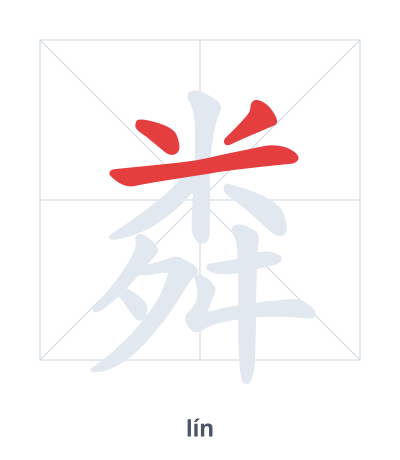
Open Hanzi Writer to see the animated stroke order and practice writing 粦 with real-time feedback.
The character 粦 (lín) is written with 12 strokes. Follow the standard Chinese stroke order: top to bottom, left to right, outside before inside. The radical 米 is one of its key components.
Practice the correct stroke order with the Hanzi Writer app to see animated stroke-by-stroke guidance with real-time feedback.
粦 means phosphorus (archaic variant).
粦 combines 米 (rice, suggesting small grains) with 舛 (opposite feet, implying movement or scattering), originally depicting tiny glowing sparks or fireflies that float and move, like phosphorescent particles.
💡 Memory Tip: Imagine glowing rice grains with little feet (舛) scattering and dancing in the dark — that's the archaic character for phosphorus.
传说夜里能看到粦火。
chuán shuō yè lǐ néng kàn dào lín huǒ
Legend says ghost fires (will-o'-the-wisps) can be seen at night.
这种矿石散发出粦光。
zhè zhǒng kuàng shí sàn fà chū lín guāng
This ore emits phosphorescence.
水面上闪烁着粦粦光影。
shuǐ miàn shàng shǎn shuò zhe lín lín guāng yǐng
The water surface is shimmering with light.
Open Hanzi Writer to see the animated stroke order and practice writing 粦 with real-time feedback.
✨ Animated stroke order · Handwriting recognition · HSK-graded practice · Free to use
粦 is composed of 米 (rice) on top and 舛 (opposite feet) on the bottom. The rice component suggests small particles, while the bottom part implies movement or dancing, together evoking the flickering, moving light of will-o'-the-wisp, which is one meaning of this character.