辌 (liáng) means "Ancient sleeping carriage" in Chinese. It has 12 strokes with the radical 车.
Rated 4.2/5 in difficulty (advanced).
Appears in 3+ common words including 辌车 (liáng chē), 辒辌 (wēn liáng), 卧辌 (wò liáng).
Due to its 12 strokes, Hanzi Writer's error detection shows 辌 requires focused practice — most learners need 10+ attempts for consistent accuracy.
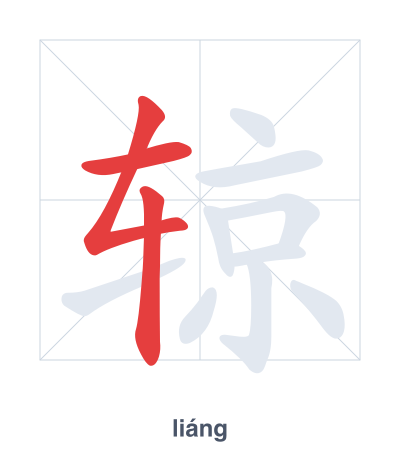
Open Hanzi Writer to see the animated stroke order and practice writing 辌 with real-time feedback.
The character 辌 (liáng) is written with 12 strokes. Follow the standard Chinese stroke order: top to bottom, left to right, outside before inside. The radical 车 is one of its key components.
Practice the correct stroke order with the Hanzi Writer app to see animated stroke-by-stroke guidance with real-time feedback.
辌 means Ancient sleeping carriage.
辌 combines the radical 车 (vehicle) with 京 (capital or tall), suggesting a large, tall-roofed carriage. In ancient China, such carriages were curtained and used for sleeping during long journeys. The component 京 also provides a phonetic clue, though the pronunciation shifted to liáng.
💡 Memory Tip: Picture a carriage (车) with a tall, house-like canopy (京) where you can lie down and sleep during a long trip.
古代有辌车。
gǔ dài yǒu liáng chē
There were sleeping carriages in ancient times.
辒辌是古代的车。
wēn liáng shì gǔ dài de chē
The Wenliang is an ancient carriage.
他坐在卧辌里。
tā zuò zài wò liáng lǐ
He is sitting in a sleeping carriage.
Open Hanzi Writer to see the animated stroke order and practice writing 辌 with real-time feedback.
✨ Animated stroke order · Handwriting recognition · HSK-graded practice · Free to use
The character 辌 is made of two parts: the left side 车 (chē) meaning 'vehicle,' and the right side 良 (liáng) which gives the sound. Since 车 shows it is a type of carriage, and the whole character means an ancient sleeping carriage, the structure tells you it is a vehicle (车) for resting.