呖 (lì) means "chirping sound (onomatopoeia)" in Chinese. It has 7 strokes with the radical 口.
Rated 3.5/5 in difficulty (challenging).
Appears in 3+ common words including 呖呖 (lì lì), 呖声 (lì shēng), 莺声呖呖 (yīng shēng lì lì).
Due to its 7 strokes, Hanzi Writer's error detection shows 呖 requires focused practice — most learners need 10+ attempts for consistent accuracy.
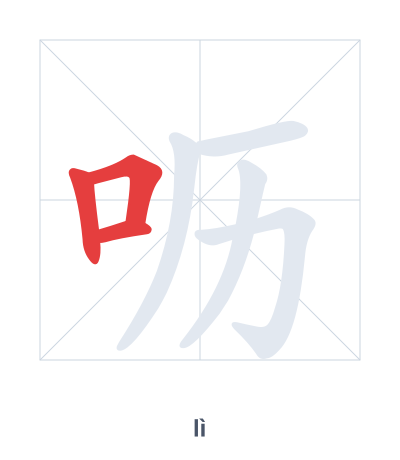
Open Hanzi Writer to see the animated stroke order and practice writing 呖 with real-time feedback.
The character 呖 (lì) is written with 7 strokes. Follow the standard Chinese stroke order: top to bottom, left to right, outside before inside. The radical 口 is one of its key components.
Practice the correct stroke order with the Hanzi Writer app to see animated stroke-by-stroke guidance with real-time feedback.
呖 means chirping sound (onomatopoeia).
呖 is a compound character formed by the mouth radical 口 and the phonetic component 历 (lì, meaning 'calendar' or 'to pass'). It functions as an onomatopoeia for chirping sounds, using the mouth symbol to indicate the sound source. This structural combination shows how the character visually represents a sound produced by the mouth, with 历 providing pronunciation.
💡 Memory Tip: Picture a mouth (口) singing along to a calendar (历) as it flips pages, with each page turn making a cheerful chirp.
鸟鸣声呖呖。
niǎo míng shēng lì lì
The bird's song is clear and melodious.
呖声非常清脆。
lì shēng fēi cháng qīng cuì
The chirping sound is very clear.
莺声呖呖真好听。
yīng shēng lì lì zhēn hǎo tīng
The oriole's song is truly pleasant to hear.
Open Hanzi Writer to see the animated stroke order and practice writing 呖 with real-time feedback.
✨ Animated stroke order · Handwriting recognition · HSK-graded practice · Free to use
呖 is made of the radical 口 (mouth) on the left and the component 历 (lì, meaning calendar) on the right. The 口 indicates that the character relates to sound, while 历 provides the pronunciation lì. Together, they create an onomatopoeia for a clear chirping sound.