蓠 (lí) means "a type of seaweed" in Chinese. It has 13 strokes with the radical 艹.
Rated 4.2/5 in difficulty (advanced).
Appears in 3+ common words including 江蓠 (jiāng lí), 蓠草 (lí cǎo), 采蓠 (cǎi lí).
Due to its 13 strokes, Hanzi Writer's error detection shows 蓠 requires focused practice — most learners need 10+ attempts for consistent accuracy.
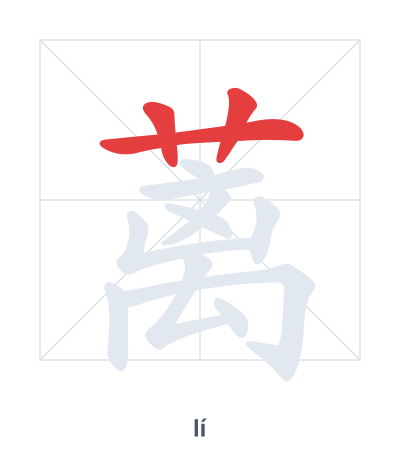
Open Hanzi Writer to see the animated stroke order and practice writing 蓠 with real-time feedback.
The character 蓠 (lí) is written with 13 strokes. Follow the standard Chinese stroke order: top to bottom, left to right, outside before inside. The radical 艹 is one of its key components.
Practice the correct stroke order with the Hanzi Writer app to see animated stroke-by-stroke guidance with real-time feedback.
蓠 means a type of seaweed.
蓠 is a compound character formed by the plant radical 艹 (grass) and the phonetic component 离 (lí, meaning 'to leave' or 'to separate'). The radical indicates that this character refers to a type of plant—specifically a kind of seaweed—while 离 provides the pronunciation.
💡 Memory Tip: Imagine a clump of seaweed (艹) that gets torn away and drifts off as it 'leaves' (离) the ocean rocks.
江蓠生长在海里。
jiāng lí shēng zhǎng zài hǎi lǐ
Gracilaria grows in the sea.
岸边有很多蓠草。
àn biān yǒu hěn duō lí cǎo
There is a lot of seaweed by the shore.
他们去海边采蓠。
tā men qù hǎi biān cǎi lí
They went to the seaside to gather seaweed.
Open Hanzi Writer to see the animated stroke order and practice writing 蓠 with real-time feedback.
✨ Animated stroke order · Handwriting recognition · HSK-graded practice · Free to use
The character 蓠 is made of the radical 艹 (grass or plant) on top, which hints that it is a type of plant. The bottom part is 离 (lí), which gives the pronunciation and originally means "to leave" but here simply acts as a phonetic component. Together, 蓠 refers to a kind of seaweed that grows in shallow water.