鳓 (lè) means "Chinese herring" in Chinese. It has 19 strokes with the radical 鱼.
Rated 4.2/5 in difficulty (advanced).
Appears in 3+ common words including 鳓鱼 (lè yú), 咸鳓鱼 (xián lè yú), 鲞鳓 (xiǎng lè).
Due to its 19 strokes, Hanzi Writer's error detection shows 鳓 requires focused practice — most learners need 10+ attempts for consistent accuracy.
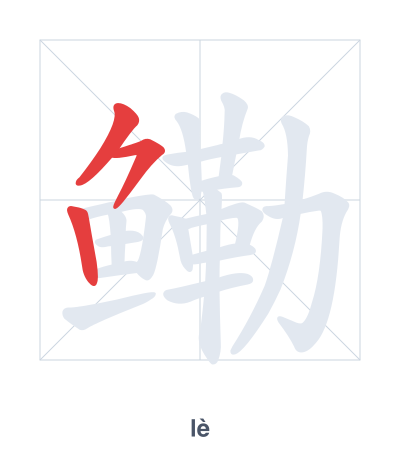
Open Hanzi Writer to see the animated stroke order and practice writing 鳓 with real-time feedback.
The character 鳓 (lè) is written with 19 strokes. Follow the standard Chinese stroke order: top to bottom, left to right, outside before inside. The radical 鱼 is one of its key components.
Practice the correct stroke order with the Hanzi Writer app to see animated stroke-by-stroke guidance with real-time feedback.
鳓 means Chinese herring.
鳓 is a phono-semantic compound where 鱼 (fish) indicates the meaning and 勒 (lè, to rein in or carve) provides the pronunciation. The presence of 鱼 clearly marks it as a type of fish, while the phonetic component helps recall the sound.
💡 Memory Tip: Picture a fish (鱼) wearing a leather harness (勒) like a horse, because this Chinese herring is strong and fast like a horse of the sea.
鳓鱼是一种美味的海鱼。
lè yú shì yī zhǒng měi wèi de hǎi yú
Chinese herring is a delicious sea fish.
咸鳓鱼吃起来非常香。
xián lè yú chī qǐ lái fēi cháng xiāng
Salted Chinese herring tastes very delicious.
鲞鳓是当地的特色食品。
xiǎng lè shì dāng dì de tè sè shí pǐn
Dried Chinese herring is a local specialty.
Open Hanzi Writer to see the animated stroke order and practice writing 鳓 with real-time feedback.
✨ Animated stroke order · Handwriting recognition · HSK-graded practice · Free to use
The character 鳓 is composed of the radical 鱼 (fish) on the left, indicating it is a type of fish, and the phonetic component 勒 (lè) on the right, which gives the pronunciation. The right part 勒 does not contribute to the meaning, so the character simply means "Chinese herring" as a fish name.