盔 (kuī) means "helmet" in Chinese. It has 11 strokes with the radical 皿.
Rated 4.2/5 in difficulty (advanced).
Appears in 3+ common words including 头盔 (tóu kuī), 盔甲 (kuī jiǎ), 钢盔 (gāng kuī).
Due to its 11 strokes, Hanzi Writer's error detection shows 盔 requires focused practice — most learners need 10+ attempts for consistent accuracy.
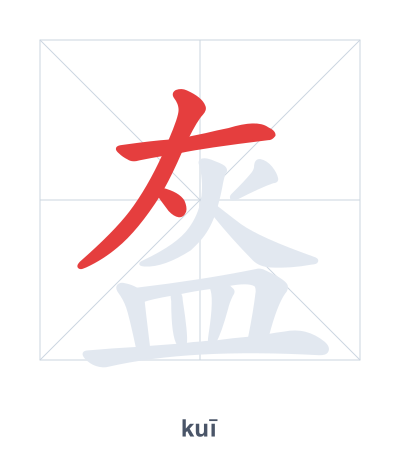
Open Hanzi Writer to see the animated stroke order and practice writing 盔 with real-time feedback.
The character 盔 (kuī) is written with 11 strokes. Follow the standard Chinese stroke order: top to bottom, left to right, outside before inside. The radical 皿 is one of its key components.
Practice the correct stroke order with the Hanzi Writer app to see animated stroke-by-stroke guidance with real-time feedback.
盔 means helmet.
| Character | 盔 |
| Pinyin | kuī (kui) |
| Meaning | helmet |
| Strokes | 11 |
| Radical | 皿 |
| Difficulty | 4.2/5 |
盔 is a compound character combining 皿 (vessel/bowl) and 灰 (ash). The bowl shape represents a helmet covering the head, while 灰 may hint at the material or color of ancient helmets.
💡 Memory Tip: Picture a helmet shaped like a bowl (皿) made of gray ash (灰) that you put on your head for protection.
骑摩托车要戴头盔。
qí mó tuō chē yào dài tóu kuī
You must wear a helmet when riding a motorcycle.
古代的士兵穿着盔甲。
gǔ dài dī shì bīng chuān zhe kuī jiǎ
Ancient soldiers wore armor.
那个士兵戴着钢盔。
nà ge shì bīng dài zhe gāng kuī
That soldier is wearing a steel helmet.
Open Hanzi Writer to see the animated stroke order and practice writing 盔 with real-time feedback.
✨ Animated stroke order · Handwriting recognition · HSK-graded practice · Free to use
盔 is made of 灰 (ash) on top and 皿 (vessel) at the bottom. The 皿 radical suggests a container, which relates to a helmet covering the head like a bowl. The top part 灰 provides visual and phonetic hints, though its original meaning of 'ash' is not directly connected to helmets.