贶 (kuàng) means "Bestow; grant (literary)" in Chinese. It has 9 strokes with the radical 贝.
Rated 4/5 in difficulty (challenging).
Appears in 3+ common words including 赐贶 (cì kuàng), 贶赠 (kuàng zèng), 厚贶 (hòu kuàng).
Due to its 9 strokes, Hanzi Writer's error detection shows 贶 requires focused practice — most learners need 10+ attempts for consistent accuracy.
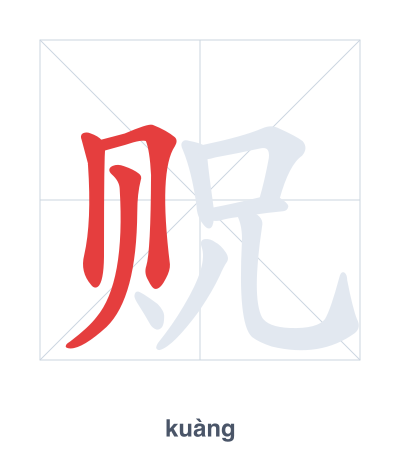
Open Hanzi Writer to see the animated stroke order and practice writing 贶 with real-time feedback.
The character 贶 (kuàng) is written with 9 strokes. Follow the standard Chinese stroke order: top to bottom, left to right, outside before inside. The radical 贝 is one of its key components.
Practice the correct stroke order with the Hanzi Writer app to see animated stroke-by-stroke guidance with real-time feedback.
贶 means Bestow; grant (literary).
This character is a phonetic compound combining 贝 (shell, representing wealth or gifts) with 兄 (elder brother) as a phonetic component. It originally conveyed the idea of bestowing or granting a gift, often by a superior to an inferior.
💡 Memory Tip: Picture your elder brother (兄) generously handing you a precious shell (贝) as a gift.
感谢您的厚意赐贶。
gǎn xiè nín de hòu yì cì kuàng
Thank you for your kindness and generous gift.
这是他贶赠的礼物。
zhè shì tā kuàng zèng de lǐ wù
This is a gift graciously bestowed by him.
承蒙厚贶,非常感谢。
chéng méng hòu kuàng fēi cháng gǎn xiè
I am very grateful for your generous gift.
Open Hanzi Writer to see the animated stroke order and practice writing 贶 with real-time feedback.
✨ Animated stroke order · Handwriting recognition · HSK-graded practice · Free to use
The left side 贝 (shell) represents money or valuables, indicating the character relates to gifts. The right side 兄 (elder brother) gives the sound 'kuàng' and suggests the idea of an elder sibling bestowing something valuable.