夼 (kuǎng) means "valley (often used in place names)" in Chinese. It has 6 strokes with the radical 大.
Rated 3.2/5 in difficulty (challenging).
Appears in 3+ common words including 大夼 (dà kuǎng), 山夼 (shān kuǎng), 夼里 (kuǎng lǐ).
Due to its 6 strokes, Hanzi Writer's error detection shows 夼 requires focused practice — most learners need 10+ attempts for consistent accuracy.
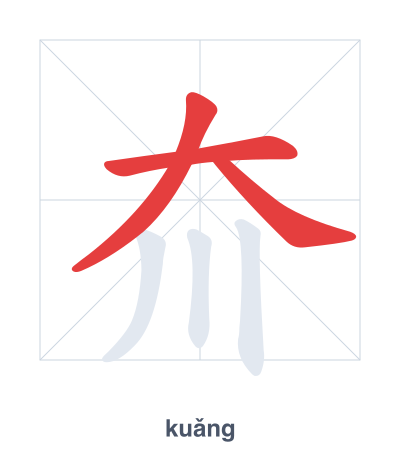
Open Hanzi Writer to see the animated stroke order and practice writing 夼 with real-time feedback.
The character 夼 (kuǎng) is written with 6 strokes. Follow the standard Chinese stroke order: top to bottom, left to right, outside before inside. The radical 大 is one of its key components.
Practice the correct stroke order with the Hanzi Writer app to see animated stroke-by-stroke guidance with real-time feedback.
夼 means valley (often used in place names).
夼 combines the radical 大 (big) with 川 (river/stream). The image is of a large stream cutting through land, forming a valley often used in place names.
💡 Memory Tip: Picture a giant (大) river (川) roaring through a wide valley, carving the shape of the character itself.
大夼是一个地名。
dà kuǎng shì yí gè dì míng
Dakuang is a place name.
山夼里有很多树。
shān kuǎng lǐ yǒu hěn duō shù
There are many trees in the mountain valley.
他家住在那个夼里。
tā jiā zhù zài nà ge kuǎng lǐ
His family lives in that mountain hollow.
Open Hanzi Writer to see the animated stroke order and practice writing 夼 with real-time feedback.
✨ Animated stroke order · Handwriting recognition · HSK-graded practice · Free to use
夼 is made of 大 (big) on top and 川 (river) on the bottom. The big 大 over a river suggests a large valley or gully where water flows, which matches the meaning "valley."