侉 (kuǎ) means "having a non-local accent; boorish" in Chinese. It has 8 strokes with the radical 亻.
Rated 3.4/5 in difficulty (challenging).
Appears in 3+ common words including 侉子 (kuǎ zi), 侉腔 (kuǎ qiāng), 侉话 (kuǎ huà).
Due to its 8 strokes, Hanzi Writer's error detection shows 侉 requires focused practice — most learners need 10+ attempts for consistent accuracy.
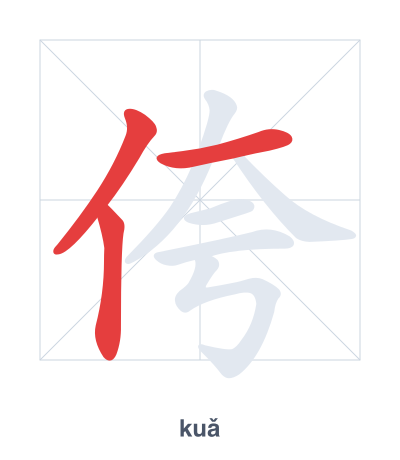
Open Hanzi Writer to see the animated stroke order and practice writing 侉 with real-time feedback.
The character 侉 (kuǎ) is written with 8 strokes. Follow the standard Chinese stroke order: top to bottom, left to right, outside before inside. The radical 亻 is one of its key components.
Practice the correct stroke order with the Hanzi Writer app to see animated stroke-by-stroke guidance with real-time feedback.
侉 means having a non-local accent; boorish.
侉 combines the radical 亻 (person) with 夸 (kuā, meaning 'to boast' or 'exaggerate'). A person who speaks with an exaggerated or boastful tone is perceived as having a non-local accent or being boorish. The compound suggests a person whose speech sounds overdone or out of place.
💡 Memory Tip: Imagine a person (亻) who opens their mouth wide (like 夸, with 大 for 'big') and speaks loudly in a strange accent, making everyone think they are a boor.
他骑着一辆旧侉子。
tā qí zhe yī liàng jiù kuǎ zi
He was riding an old sidecar motorcycle.
他的侉腔很有意思。
tā de kuǎ qiāng hěn yǒu yì si
His regional accent is very interesting.
他说了一句地道的侉话。
tā shuō le yī jù dì dào de kuǎ huà
He spoke in an authentic non-local accent.
Open Hanzi Writer to see the animated stroke order and practice writing 侉 with real-time feedback.
✨ Animated stroke order · Handwriting recognition · HSK-graded practice · Free to use
The character 侉 is made of the left radical 亻, meaning 'person', and the right part 夸 (kuā). The radical shows it is about a person, while 夸 gives the sound and hints at 'boasting' or 'exaggerating', which connects to someone whose accent stands out strongly.