剀 (kǎi) means "earnest; appropriate" in Chinese. It has 8 strokes with the radical 刂.
Rated 3.4/5 in difficulty (challenging).
Appears in 3+ common words including 剀切 (kǎi qiè), 剀直 (kǎi zhí), 剀到 (kǎi dào).
Due to its 8 strokes, Hanzi Writer's error detection shows 剀 requires focused practice — most learners need 10+ attempts for consistent accuracy.
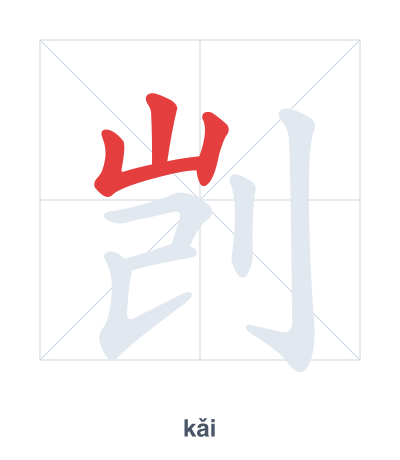
Open Hanzi Writer to see the animated stroke order and practice writing 剀 with real-time feedback.
The character 剀 (kǎi) is written with 8 strokes. Follow the standard Chinese stroke order: top to bottom, left to right, outside before inside. The radical 刂 is one of its key components.
Practice the correct stroke order with the Hanzi Writer app to see animated stroke-by-stroke guidance with real-time feedback.
剀 means earnest; appropriate.
剀 is a phono-semantic compound where 刂 (knife) suggests cutting or action, and 岂 (kǎi) provides the pronunciation. The meaning 'earnest; appropriate' likely derives from the idea of cutting something precisely to fit, like tailoring words or actions to be just right.
💡 Memory Tip: Picture a knife (刂) slicing the character 岂 into the perfect earnest shape, as if trimming away excess to make it appropriate.
他的话十分剀切。
tā de huà shí fēn kǎi qiè
His words were very pertinent.
他的建议很剀直。
tā de jiàn yì hěn kǎi zhí
His suggestion is very straightforward.
他的分析很剀到。
tā de fēn xī hěn kǎi dào
His analysis is very pertinent.
Open Hanzi Writer to see the animated stroke order and practice writing 剀 with real-time feedback.
✨ Animated stroke order · Handwriting recognition · HSK-graded practice · Free to use
剀 is composed of the left part 岂 (which provides a phonetic clue) and the right radical 刂 (knife). The knife radical suggests cutting or striking, and combined with the sound kǎi, the character conveys the idea of being earnest and direct — like cutting straight to the point.