Hanzi Writer

How to Write 莒 (jǔ) — Meaning “Ju (an ancient state or place name)”

9 strokes Radical: 艹

莒 (jǔ) means "Ju (an ancient state or place name)" in Chinese. It has 9 strokes with the radical 艹.

Rated 4/5 in difficulty (challenging).

Appears in 3+ common words including 莒县 (jǔ xiàn), 莒国 (jǔ guó), 莒文化 (jǔ wén huà).

Due to its 9 strokes, Hanzi Writer's error detection shows 莒 requires focused practice — most learners need 10+ attempts for consistent accuracy.
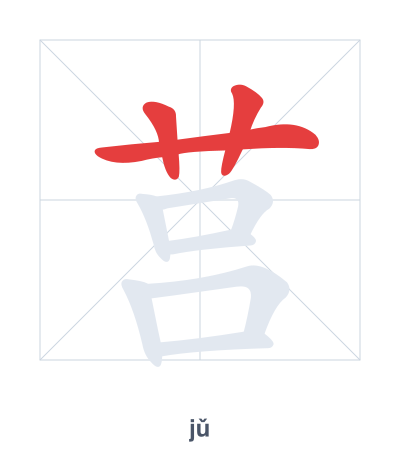
Stroke order practice for 莒 - jǔ

Practice Writing 莒 (jǔ)

Open Hanzi Writer to see the animated stroke order and practice writing 莒 with real-time feedback.

The character (jǔ) is written with 9 strokes. Follow the standard Chinese stroke order: top to bottom, left to right, outside before inside. The radical is one of its key components.

Practice the correct stroke order with the Hanzi Writer app to see animated stroke-by-stroke guidance with real-time feedback.

means Ju (an ancient state or place name).

Character
Pinyinjǔ (ju)
MeaningJu (an ancient state or place name)
Strokes9
Radical
Difficulty4/5

莒 is a phono-semantic compound: the radical 艹 (grass) suggests a plant or a place with vegetation, while 吕 (lǚ, originally two vertebrae but used here for sound) contributes the pronunciation. It refers to an ancient state (located in modern Shandong) and a place name, with no direct visual link to the meaning beyond the grass radical indicating a region.

💡 Memory Tip: Imagine two mouths (吕) chatting under a canopy of grass (艹) at the ancient state of Ju.

jǔ xiàn
Ju County
jǔ guó
The State of Ju
jǔ wén huà
Ju culture

莒县是一个古老的地方。

jǔ xiàn shì yí gè gǔ lǎo de dì fāng

Ju County is an ancient place.

历史上曾经有一个莒国。

lì shǐ shàng céng jīng yǒu yí gè jǔ guó

There was once a State of Ju in history.

莒文化具有研究价值。

jǔ wén huà jù yǒu yán jiū jià zhí

Ju culture has significant research value.

Character Pinyin Strokes Radical
(current) 9
9
7
7
Stroke order practice for 莒 - jǔ

Practice Writing 莒 (jǔ)

Open Hanzi Writer to see the animated stroke order and practice writing 莒 with real-time feedback.

✨ Animated stroke order · Handwriting recognition · HSK-graded practice · Free to use

Frequently Asked Questions about 莒

莒 is made of the radical 艹 (grass) on top and 吕 (lǚ, meaning "two mouths") below. Although the grass radical hints at a plant-related origin, the character is actually a proper noun used for an ancient state and place name. Its meaning comes from historical usage, not from its literal components.

Characters with Radical 艹

Other 9-Stroke Characters