驹 (jū) means "foal; colt; young horse" in Chinese. It has 8 strokes with the radical 马.
Rated 3.7/5 in difficulty (challenging).
Appears in 3+ common words including 马驹 (mǎ jū), 白驹过隙 (bái jū guò xì), 千里驹 (qiān lǐ jū).
Due to its 8 strokes, Hanzi Writer's error detection shows 驹 requires focused practice — most learners need 10+ attempts for consistent accuracy.
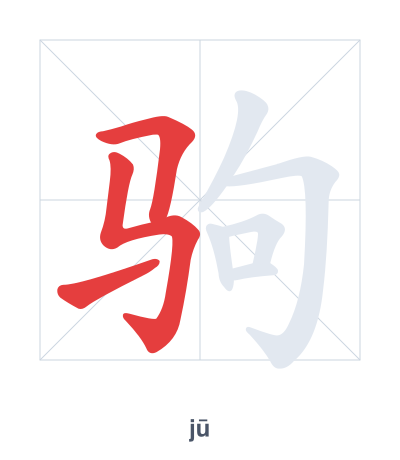
Open Hanzi Writer to see the animated stroke order and practice writing 驹 with real-time feedback.
The character 驹 (jū) is written with 8 strokes. Follow the standard Chinese stroke order: top to bottom, left to right, outside before inside. The radical 马 is one of its key components.
Practice the correct stroke order with the Hanzi Writer app to see animated stroke-by-stroke guidance with real-time feedback.
驹 means foal; colt; young horse.
驹 combines the radical 马 (horse) with the phonetic component 句 (jū, meaning 'sentence' but here purely for sound). The character indicates a young horse, a foal or colt, with 马 providing the semantic clue and 句 the pronunciation.
💡 Memory Tip: Picture a little foal (马) playfully hooking its tiny hoof over a speech bubble (句) to say 'ju!' as its first word.
这只小马驹真可爱。
zhè zhǐ xiǎo mǎ jū zhēn kě ài
This little foal is so cute.
时间过得真快,白驹过隙。
shí jiān guò dé zhēn kuài bái jū guò xì
Time passes so fast, like a fleeting moment.
这匹马真是一匹千里驹。
zhè pǐ mǎ zhēn shì yì pǐ qiān lǐ jū
This horse is truly a prized steed.
Open Hanzi Writer to see the animated stroke order and practice writing 驹 with real-time feedback.
✨ Animated stroke order · Handwriting recognition · HSK-graded practice · Free to use
驹 is a left-right character. The left part 马 is the radical for horse, indicating that the character relates to horses. The right part 句 (jù) provides the approximate sound, making it a phonetic-semantic compound where the meaning 'foal' comes from the horse radical.