椐 (jū) means "A type of thorny tree" in Chinese. It has 12 strokes with the radical 木.
Rated 4.2/5 in difficulty (advanced).
Appears in 3+ common words including 椐木 (jū mù), 椐杖 (jū zhàng), 灵椐 (líng jū).
Due to its 12 strokes, Hanzi Writer's error detection shows 椐 requires focused practice — most learners need 10+ attempts for consistent accuracy.
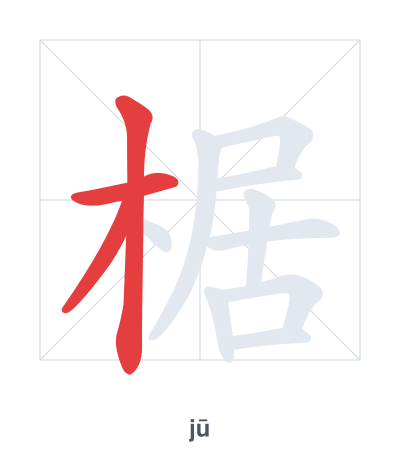
Open Hanzi Writer to see the animated stroke order and practice writing 椐 with real-time feedback.
The character 椐 (jū) is written with 12 strokes. Follow the standard Chinese stroke order: top to bottom, left to right, outside before inside. The radical 木 is one of its key components.
Practice the correct stroke order with the Hanzi Writer app to see animated stroke-by-stroke guidance with real-time feedback.
椐 means A type of thorny tree.
椐 is a phono-semantic compound. The radical 木 (tree) indicates it is a type of tree, while 居 (jū) provides the pronunciation. The character refers to a thorny tree mentioned in classical Chinese texts.
💡 Memory Tip: Picture a tree (木) so covered in thorns that no one can dwell (居) beneath it.
这种家具是用椐木做的。
zhè zhǒng jiā jù shì yòng jū mù zuò de
This furniture is made of knotty wood.
老人手里拿着一根椐杖。
lǎo rén shǒu lǐ ná zhe yī gēn jū zhàng
The elderly person is holding a walking stick made of bird cherry wood.
山林里生长着灵椐。
shān lín lǐ shēng zhǎng zhe líng jū
Sacred trees grow in the mountain forest.
Open Hanzi Writer to see the animated stroke order and practice writing 椐 with real-time feedback.
✨ Animated stroke order · Handwriting recognition · HSK-graded practice · Free to use
椐 is composed of the radical 木 (wood/tree) on the left and 居 (jū, meaning 'to dwell') on the right. The left part shows it is a type of tree, while the right part provides pronunciation. Together, they indicate a thorny tree used for making walking sticks or funeral carriages.