柩 (jiù) means "coffin (with a corpse)" in Chinese. It has 9 strokes with the radical 木.
Rated 4/5 in difficulty (challenging).
Appears in 3+ common words including 灵柩 (líng jiù), 运柩 (yùn jiù), 移柩 (yí jiù).
Due to its 9 strokes, Hanzi Writer's error detection shows 柩 requires focused practice — most learners need 10+ attempts for consistent accuracy.
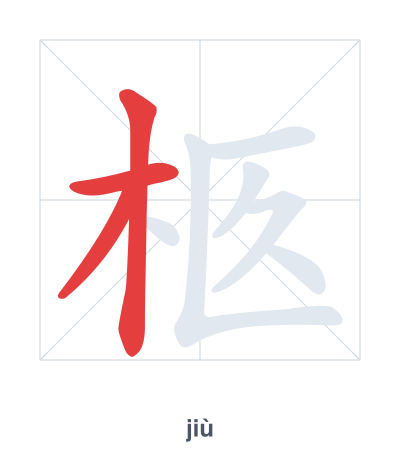
Open Hanzi Writer to see the animated stroke order and practice writing 柩 with real-time feedback.
The character 柩 (jiù) is written with 9 strokes. Follow the standard Chinese stroke order: top to bottom, left to right, outside before inside. The radical 木 is one of its key components.
Practice the correct stroke order with the Hanzi Writer app to see animated stroke-by-stroke guidance with real-time feedback.
柩 means coffin (with a corpse).
柩 combines the radical 木 (wood, indicating material) with 匚 (a box-like enclosure) and 久 (long time), together suggesting a wooden container that holds a corpse for a long duration. Ancient forms show a coffin made of wood, with the enclosing shape emphasizing the final resting place.
💡 Memory Tip: Imagine a wooden box (木+匚) where a corpse has been lying for ages (久)—that's a coffin you'll never forget.
灵柩停放在大厅。
líng jiù tíng fàng zài dà tīng
The coffin is placed in the hall.
运柩车缓缓开动。
yùn jiù chē huǎn huǎn kāi dòng
The hearse started moving slowly.
明天举行移柩仪式。
míng tiān jǔ xíng yí jiù yí shì
The coffin removal ceremony will be held tomorrow.
Open Hanzi Writer to see the animated stroke order and practice writing 柩 with real-time feedback.
✨ Animated stroke order · Handwriting recognition · HSK-graded practice · Free to use
柩 is made of the radical 木 (wood) on the left, and the right part 匚 (a box) enclosing 久 (long time). Together, they suggest a wooden box that holds a body for a long time, which is a coffin with a corpse.