樛 (jiū) means "to bend downward; drooping" in Chinese. It has 15 strokes with the radical 木.
Rated 4.2/5 in difficulty (advanced).
Appears in 3+ common words including 樛木 (jiū mù), 樛枝 (jiū zhī), 樛流 (jiū liú).
Due to its 15 strokes, Hanzi Writer's error detection shows 樛 requires focused practice — most learners need 10+ attempts for consistent accuracy.
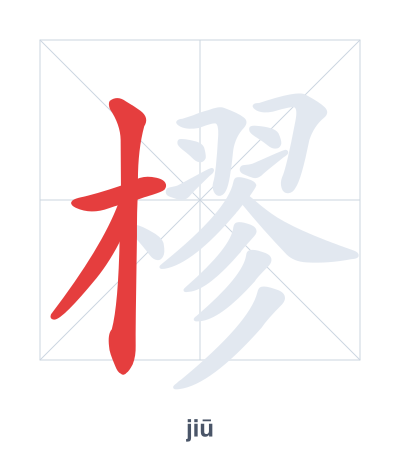
Open Hanzi Writer to see the animated stroke order and practice writing 樛 with real-time feedback.
The character 樛 (jiū) is written with 15 strokes. Follow the standard Chinese stroke order: top to bottom, left to right, outside before inside. The radical 木 is one of its key components.
Practice the correct stroke order with the Hanzi Writer app to see animated stroke-by-stroke guidance with real-time feedback.
樛 means to bend downward; drooping.
樛 is a compound character with the tree radical 木 (mù) on the left, indicating a tree, and 翏 (liù) on the right, which originally depicted a person with a feathered headdress bending forward. Together, they suggest a tree that bends or droops downward, as if bowing under weight.
💡 Memory Tip: Imagine a tree (木) whose top is so heavy it droops over, forming the curled shape of 翏 like a bending neck.
樛木向下弯曲。
jiū mù xiàng xià wān qū
The drooping tree bends downward.
树上有许多樛枝。
shù shàng yǒu xǔ duō jiū zhī
There are many curving branches on the tree.
水流在山间樛流。
shuǐ liú zài shān jiān jiū liú
The water winds through the mountains.
Open Hanzi Writer to see the animated stroke order and practice writing 樛 with real-time feedback.
✨ Animated stroke order · Handwriting recognition · HSK-graded practice · Free to use
樛 is composed of the radical 木 (tree) on the left and the phonetic component 翏 on the right. 翏 originally meant "to wind" or "to bind," which combines with 木 to suggest a tree with branches that bend downward or droop. This structure directly reflects the character's meaning of "to bend downward" or "drooping."