菅 (jiān) means "Coarse grass (Themeda triandra)" in Chinese. It has 11 strokes with the radical 艹.
Rated 4.2/5 in difficulty (advanced).
Appears in 3+ common words including 菅草 (jiān cǎo), 草菅人命 (cǎo jiān rén mìng), 茅菅 (máo jiān).
Due to its 11 strokes, Hanzi Writer's error detection shows 菅 requires focused practice — most learners need 10+ attempts for consistent accuracy.
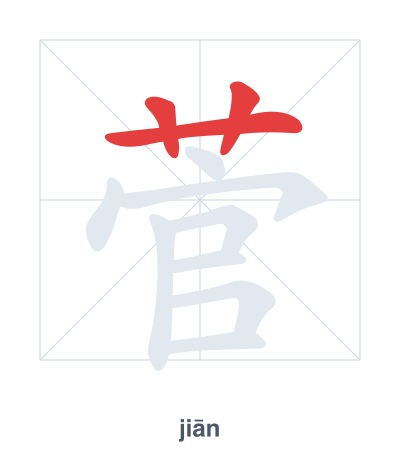
Open Hanzi Writer to see the animated stroke order and practice writing 菅 with real-time feedback.
The character 菅 (jiān) is written with 11 strokes. Follow the standard Chinese stroke order: top to bottom, left to right, outside before inside. The radical 艹 is one of its key components.
Practice the correct stroke order with the Hanzi Writer app to see animated stroke-by-stroke guidance with real-time feedback.
菅 means Coarse grass (Themeda triandra).
菅 is a phono-semantic compound: the grass radical (艹) signifies it is a type of plant, while 官 (an official) acts as a phonetic component indicating the pronunciation jiān. It refers to a coarse grass (Themeda triandra) often used for thatching or fodder.
💡 Memory Tip: Picture an official (官) lying uncomfortably on a bed of coarse grass (艹), scratching and saying 'Jiān!' in annoyance.
山上长满了菅草。
shān shàng zhǎng mǎn le jiān cǎo
The mountain is covered with cogon grass.
我们不能草菅人命。
wǒ men bù néng cǎo jiān rén mìng
We cannot treat human life with utter disregard.
他用茅菅盖房子。
tā yòng máo jiān gài fáng zi
He used cogon grass to build the house.
Open Hanzi Writer to see the animated stroke order and practice writing 菅 with real-time feedback.
✨ Animated stroke order · Handwriting recognition · HSK-graded practice · Free to use
菅 is composed of the grass radical 艹 on top and the phonetic component 官 (guān) below. The grass radical indicates the character relates to plants, while 官 provides a clue to pronunciation. Together, they form the meaning of a specific type of coarse grass.