浍 (huì) means "Hui (used in river and place names)" in Chinese. It has 9 strokes with the radical 氵.
Rated 4/5 in difficulty (challenging).
Appears in 3+ common words including 浍河 (huì hé), 浍水 (huì shuǐ), 浍南 (huì nán).
Due to its 9 strokes, Hanzi Writer's error detection shows 浍 requires focused practice — most learners need 10+ attempts for consistent accuracy.
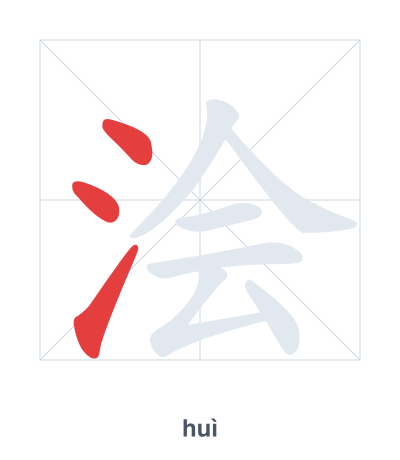
Open Hanzi Writer to see the animated stroke order and practice writing 浍 with real-time feedback.
The character 浍 (huì) is written with 9 strokes. Follow the standard Chinese stroke order: top to bottom, left to right, outside before inside. The radical 氵 is one of its key components.
Practice the correct stroke order with the Hanzi Writer app to see animated stroke-by-stroke guidance with real-time feedback.
浍 means Hui (used in river and place names).
浍 combines the water radical 氵 with 会 (meeting/hui), its phonetic component, to depict a place where waters converge. Originally named a specific river in ancient China, it now appears in river and place names, emphasizing the confluence of streams.
💡 Memory Tip: Picture a river (氵) where multiple streams come together in a meeting (会) to form a larger waterway called 浍.
浍河就在学校旁边。
huì hé jiù zài xué xiào páng biān
The Hui River is right next to the school.
浍水流向远方。
huì shuǐ liú xiàng yuǎn fāng
The Hui River flows into the distance.
他家在浍南镇。
tā jiā zài huì nán zhèn
His family is in Huinan Town.
Open Hanzi Writer to see the animated stroke order and practice writing 浍 with real-time feedback.
✨ Animated stroke order · Handwriting recognition · HSK-graded practice · Free to use
浍 is made of the water radical 氵 on the left and 会 (huì, meaning 'to meet' or 'assembly') on the right. The water radical indicates that the character refers to a river or body of water, and the pronunciation comes from 会, which also hints at the character's sound, huì. Together, 浍 is used specifically in the names of rivers like the Hui River.