锾 (huán) means "Ancient unit of currency; monetary fine" in Chinese. It has 14 strokes with the radical 钅.
Rated 4.2/5 in difficulty (advanced).
Appears in 3+ common words including 罚锾 (fá huán), 锾金 (huán jīn), 锾数 (huán shù).
Due to its 14 strokes, Hanzi Writer's error detection shows 锾 requires focused practice — most learners need 10+ attempts for consistent accuracy.
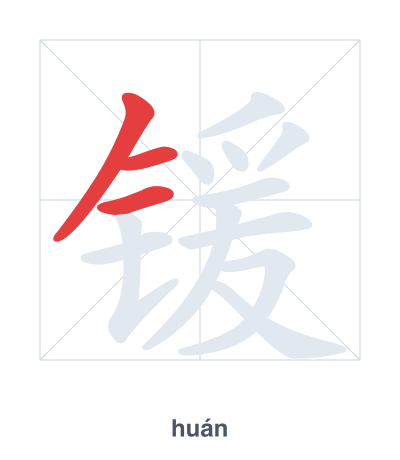
Open Hanzi Writer to see the animated stroke order and practice writing 锾 with real-time feedback.
The character 锾 (huán) is written with 14 strokes. Follow the standard Chinese stroke order: top to bottom, left to right, outside before inside. The radical 钅 is one of its key components.
Practice the correct stroke order with the Hanzi Writer app to see animated stroke-by-stroke guidance with real-time feedback.
锾 means Ancient unit of currency; monetary fine.
锾 is a phono-semantic compound combining the radical 钅 (metal, money) with 爰, which originally meant 'to pull' but here provides a phonetic hint. The character represents an ancient unit of currency or a monetary fine, reflecting the use of metal as a medium of exchange or penalty.
💡 Memory Tip: Picture a metal coin (钅) being handed over by a hand (爰) as payment for a fine.
他交了一笔罚锾。
tā jiāo le yī bǐ fá huán
He paid a fine.
古代用锾金做交易。
gǔ dài yòng huán jīn zuò jiāo yì
Ancient times used 'huan' gold for transactions.
记录下锾的数量。
jì lù xià huán de shù liàng
Record the amount of the fine.
Open Hanzi Writer to see the animated stroke order and practice writing 锾 with real-time feedback.
✨ Animated stroke order · Handwriting recognition · HSK-graded practice · Free to use
锾 is composed of the radical 钅 (metal) on the left and 爰 (yuán) on the right. The metal radical hints at currency or objects made of metal, while 爰 originally meant 'to lead or pull,' but here it primarily provides the sound huán. Together, they form a character that refers to a unit of ancient currency or a monetary fine.