轫 (rèn) means "A chock or block to stop a wheel" in Chinese. It has 7 strokes with the radical 车.
Rated 3.5/5 in difficulty (challenging).
Appears in 3+ common words including 发轫 (fā rèn), 轫木 (rèn mù), 轫石 (rèn shí).
Due to its 7 strokes, Hanzi Writer's error detection shows 轫 requires focused practice — most learners need 10+ attempts for consistent accuracy.
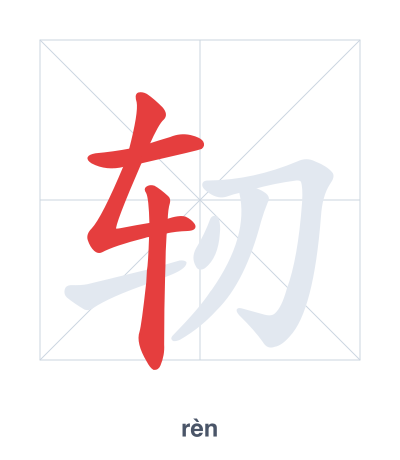
Open Hanzi Writer to see the animated stroke order and practice writing 轫 with real-time feedback.
The character 轫 (rèn) is written with 7 strokes. Follow the standard Chinese stroke order: top to bottom, left to right, outside before inside. The radical 车 is one of its key components.
Practice the correct stroke order with the Hanzi Writer app to see animated stroke-by-stroke guidance with real-time feedback.
轫 means A chock or block to stop a wheel.
The character 轫 combines the radical 车 (vehicle/wheel) with 刃 (blade), suggesting a wedge that cuts into a wheel to halt its motion. In ancient practice, a chock was a sharp piece placed under a wheel to stop a cart, much like a blade stopping rotation.
💡 Memory Tip: Picture a wheel (车) rolling into a sharp blade (刃) that jams it, bringing the cart to an abrupt stop.
事业刚刚发轫。
shì yè gāng gāng fā rèn
The career has just begun.
用轫木挡住车。
yòng rèn mù dǎng zhù chē
Block the car with a wheel chock.
轫石在车轮下。
rèn shí zài chē lún xià
The chock stone is under the wheel.
Open Hanzi Writer to see the animated stroke order and practice writing 轫 with real-time feedback.
✨ Animated stroke order · Handwriting recognition · HSK-graded practice · Free to use
The character 轫 is composed of two parts: the left radical 车 (chē), meaning 'vehicle' or 'wheel', and the right component 刃 (rèn), meaning 'blade' or 'edge'. The radical gives the general meaning related to vehicles, while 刃 provides the pronunciation and also suggests a sharp object that can block a wheel. Together, they form the idea of a 'wheel chock'—something that stops a wheel from moving.