楛 (hù) means "coarse / shoddy" in Chinese. It has 13 strokes with the radical 木.
Rated 4.2/5 in difficulty (advanced).
Appears in 3+ common words including 楛窳 (hù yǔ), 楛木 (hù mù), 楛矢 (hù shǐ).
Due to its 13 strokes, Hanzi Writer's error detection shows 楛 requires focused practice — most learners need 10+ attempts for consistent accuracy.
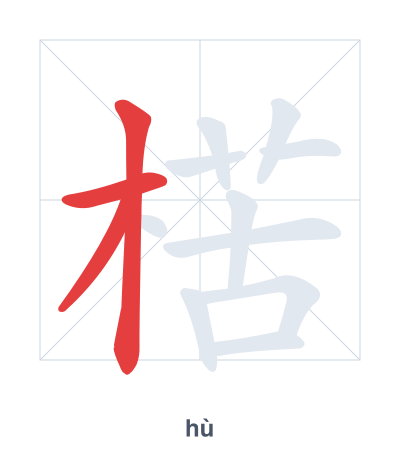
Open Hanzi Writer to see the animated stroke order and practice writing 楛 with real-time feedback.
The character 楛 (hù) is written with 13 strokes. Follow the standard Chinese stroke order: top to bottom, left to right, outside before inside. The radical 木 is one of its key components.
Practice the correct stroke order with the Hanzi Writer app to see animated stroke-by-stroke guidance with real-time feedback.
楛 means coarse / shoddy.
楛 is a compound character with the 'tree' radical (木) and 'bitter' (苦) as a component. The bitterness of the tree's wood implies it is coarse and shoddy in quality, not fit for fine use.
💡 Memory Tip: Imagine a tree (木) that tastes so bitter (苦) that its wood is rough and worthless, perfect for nothing but scraping.
这些工具做得很楛窳。
zhè xiē gōng jù zuò dé hěn hù yǔ
These tools are poorly made.
山上有许多楛木。
shān shàng yǒu xǔ duō hù mù
There are many arrow-wood trees on the mountain.
他在看古老的楛矢。
tā zài kàn gǔ lǎo de hù shǐ
He is looking at an ancient viburnum arrow.
Open Hanzi Writer to see the animated stroke order and practice writing 楛 with real-time feedback.
✨ Animated stroke order · Handwriting recognition · HSK-graded practice · Free to use
The left side is 木 (wood), indicating the character relates to wood or trees. The right side is 古 (gǔ, ancient), which here suggests something old or worn-out, connecting to the meaning of coarse or shoddy quality.