辊 (gǔn) means "Roller; cylinder" in Chinese. It has 12 strokes with the radical 车.
Rated 4.2/5 in difficulty (advanced).
Appears in 3+ common words including 辊子 (gǔn zi), 压辊 (yā gǔn), 辊筒 (gǔn tǒng).
Due to its 12 strokes, Hanzi Writer's error detection shows 辊 requires focused practice — most learners need 10+ attempts for consistent accuracy.
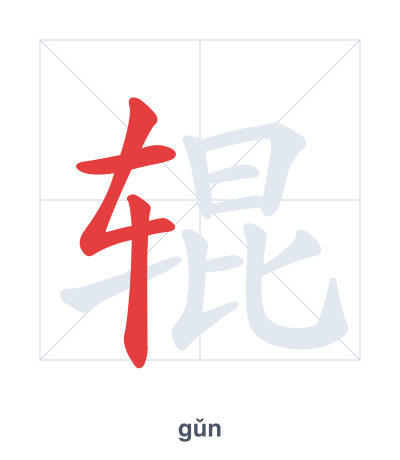
Open Hanzi Writer to see the animated stroke order and practice writing 辊 with real-time feedback.
The character 辊 (gǔn) is written with 12 strokes. Follow the standard Chinese stroke order: top to bottom, left to right, outside before inside. The radical 车 is one of its key components.
Practice the correct stroke order with the Hanzi Writer app to see animated stroke-by-stroke guidance with real-time feedback.
辊 means Roller; cylinder.
辊 is a phono-semantic compound. The left radical 车 (vehicle/wheel) indicates it relates to rollers or rotating parts, while the right component 昆 (kūn) provides the pronunciation. Together they form the meaning of a roller or cylinder used in machinery.
💡 Memory Tip: Imagine a vehicle (车) with a sun (日) and two friends (比) rolling along like a cylindrical roller.
机器里有一个辊子。
jī qì lǐ yǒu yí gè gǔn zi
There is a roller inside the machine.
压辊正在压平纸张。
yā gǔn zhèng zài yā píng zhǐ zhāng
The pressure roller is flattening the paper.
辊筒转动得很快。
gǔn tǒng zhuǎn dòng dé hěn kuài
The roller is spinning very fast.
Open Hanzi Writer to see the animated stroke order and practice writing 辊 with real-time feedback.
✨ Animated stroke order · Handwriting recognition · HSK-graded practice · Free to use
辊 is made of two parts: the radical 车 (vehicle) on the left and the phonetic component 昆 (kūn) on the right. The 车 radical suggests the character relates to vehicles or machinery, while 昆 provides pronunciation. Together, they form a character meaning 'roller' or 'cylinder' — a machine part often used in vehicles or industrial equipment.