鳜 (guì) means "mandarin fish" in Chinese. It has 20 strokes with the radical 鱼.
Rated 4.2/5 in difficulty (advanced).
Appears in 3+ common words including 鳜鱼 (guì yú), 清蒸鳜鱼 (qīng zhēng guì yú), 臭鳜鱼 (chòu guì yú).
Due to its 20 strokes, Hanzi Writer's error detection shows 鳜 requires focused practice — most learners need 10+ attempts for consistent accuracy.
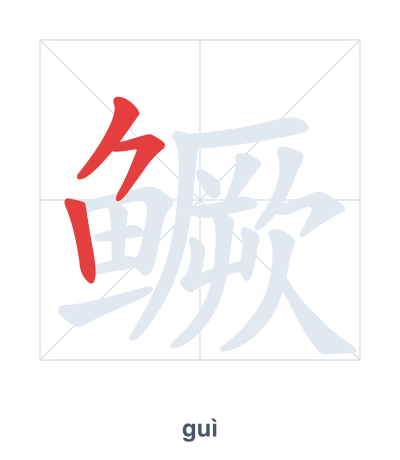
Open Hanzi Writer to see the animated stroke order and practice writing 鳜 with real-time feedback.
The character 鳜 (guì) is written with 20 strokes. Follow the standard Chinese stroke order: top to bottom, left to right, outside before inside. The radical 鱼 is one of its key components.
Practice the correct stroke order with the Hanzi Writer app to see animated stroke-by-stroke guidance with real-time feedback.
鳜 means mandarin fish.
This character is a phonetic-semantic compound. The radical 鱼 (fish) indicates it is a type of fish, while 厥 (guì) provides the sound and loosely suggests 'noble' (as in 贵, also pronounced guì), hinting at the prized status of the mandarin fish in Chinese cuisine.
💡 Memory Tip: Imagine a mandarin fish (鱼) so fancy it faints (厥) from its own elegance—a truly noble dinner.
鳜鱼的刺很少。
guì yú de cì hěn shǎo
Mandarin fish has very few bones.
妈妈做了清蒸鳜鱼。
mā mā zuò le qīng zhēng guì yú
Mom made steamed mandarin fish.
臭鳜鱼闻着臭吃着香。
chòu guì yú wén zhe chòu chī zhe xiāng
Stinky mandarin fish smells bad but tastes delicious.
Open Hanzi Writer to see the animated stroke order and practice writing 鳜 with real-time feedback.
✨ Animated stroke order · Handwriting recognition · HSK-graded practice · Free to use
The character 鳜 combines the radical 鱼 (fish) on the left with the phonetic component 厥 (jué) on the right. The radical 鱼 indicates the character relates to fish, while 厥 provides the sound cue. Together they form the name for a specific fish: the mandarin fish.